

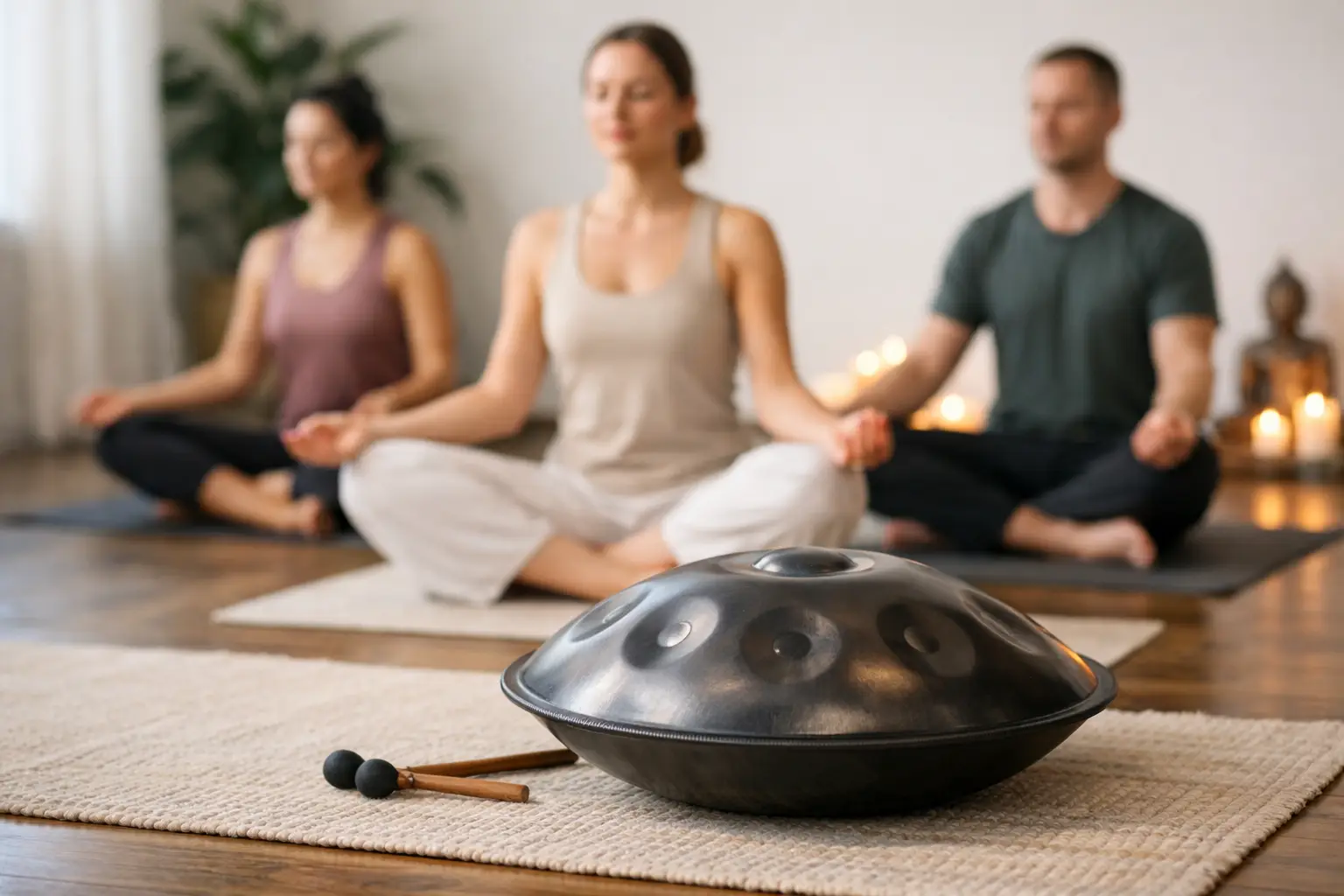
How a Handpan for Yoga Classes Shapes the Room
Handpan for Yoga.
A room can change with a single held note. Played with care, a handpan for yoga classes does not compete with the practice or tell students how to feel. It gives breath, movement and stillness a gentle musical edge – something warm enough to gather attention, yet spacious enough to leave room for each person’s own experience.
For yoga teachers, sound practitioners and musicians, that balance is the point. A handpan can bring a live, human quality to a class that a playlist cannot always offer. But it works best when it is treated as part of the teaching, not as constant background music.
Why handpan works in a yoga space
The handpan’s voice is naturally rounded and resonant. Its notes bloom after each touch, carrying melody and rhythm at once without the hard attack of many percussion instruments. In a yoga studio, that can feel grounding rather than demanding.
Most handpans are tuned to a particular scale, with notes arranged to sound harmonious together. This makes them unusually welcoming for players who do not come from a formal musical background. You can focus on listening, responding and leaving space between notes, rather than worrying that an improvised phrase will jar against the mood of the class.
That does not mean every handpan suits every session. A bright, fast pattern may lift an energising flow, but become distracting during a slow floor sequence. A dark, low register can create a beautiful sense of arrival in restorative yoga, yet may feel too weighty for a sunny morning class. The instrument is expressive because the player can shape its role.
Handpan for yoga classes: where it fits best
Live handpan is often most effective at the transitions. Begin with a few unhurried notes while students settle on their mats. Return to a simple motif as the room moves from stronger standing work towards the floor. In savasana, use sound sparingly, allowing tones to fade fully before adding another.
During a more active vinyasa class, the handpan can support a steady pace without becoming a metronome. A soft pulse on the central note, followed by occasional melodic responses, may give the sequence a sense of flow. Keep the rhythm breathable. Students need to hear cues, notice their alignment and stay connected to their own internal timing.
For yin, restorative and meditation-focused classes, less usually carries more. One note every few breaths can be enough. A familiar, quiet phrase repeated at long intervals may help create continuity, while silence gives the resonance meaning. Playing continuously can turn even a beautiful instrument into sonic clutter.
There is also a place for handpan after the movement has finished. A short live sound journey as students rest can offer a gentle landing point, particularly in small groups where the player can read the room. Avoid treating this as a performance. The aim is not to impress people with speed or complexity. It is to create a calm field of attention.
Start by serving the class, not the instrument
The strongest musical choices begin with the class plan. Before playing, consider the pace, the experience level of the group, the size of the room and whether you are teaching, playing, or doing both. A teacher who plays while cueing poses may need a much simpler musical approach than a dedicated musician supporting the session.
If you are leading and playing alone, build a small vocabulary you can return to without effort: a settling pattern, a flowing pattern and a closing pattern. Practise them until your hands can play softly while your attention stays with your students. It is better to offer three well-timed notes and a clear cue than to attempt an elaborate rhythm while losing the class.
If another musician is playing, agree on signals beforehand. Decide when music begins, where silence is needed, and how the class will move into savasana. This preparation prevents the awkward moment where a teacher raises their voice over a flourishing musical passage.
Volume deserves just as much thought. Handpans can carry further than players expect, especially in studios with hard floors, glass or bare walls. Start quieter than you think you need to. Ask yourself whether students at the back can still hear spoken guidance comfortably. In intimate rooms, a handpan often needs no amplification at all.
Choosing a scale and sound character
There is no single best handpan scale for yoga. The right choice depends on the emotional colour you want, your own ear, and the sort of sessions you intend to support.
Minor and Celtic-style scales are popular because they can feel reflective, spacious and easy to explore. They often suit slower classes, breathwork and rest. Major scales can bring clarity, warmth and a more open, uplifting quality, making them a lovely match for daytime flow or community classes. Scales with more notes offer extra melodic possibilities, though they can take longer to learn well and may tempt a new player to fill every silence.
For a first instrument, a handpan with a comfortable number of notes and a scale that genuinely moves you is usually the wisest choice. Listen beyond the first striking melody. Imagine playing only a few notes slowly for ten minutes. Does the sound still feel inviting? Can you hear a quiet conversation between the central note and the surrounding tone fields?
The physical feel matters, too. You may be carrying the instrument from home to studio, along a footpath, through a car park and into a busy class. Consider its size, weight, protective case and how confidently you can transport it. A beautiful handpan is an instrument you will want to bring out often.
Simple playing approaches that sound intentional
You do not need dense rhythms to make a handpan sound musical. In fact, yoga settings reward restraint. Let each note ring, then listen to the decay before deciding what comes next. This one habit can transform tentative playing into something grounded and deliberate.
Try beginning with the central ding note as an anchor. Add one or two nearby notes in a slow pattern, then return home. As your confidence grows, alternate a low pulse with a light melody above it. Keep your touch relaxed. The handpan responds to finesse, not force, and heavy strikes can sound sharp in a quiet room.
It helps to think in phrases rather than endless patterns. Play a short idea, pause, and let the room answer with breath and movement. When students are holding a challenging shape or listening to a detailed cue, simplify or stop. When they are settling into a long rest, a few carefully placed tones may feel more meaningful than a stream of notes.
Recording your practice on a mobile can be revealing. What feels soft beneath your hands may sound busy from across the room. Listen back at low volume, then notice whether the music supports a sense of space. This is also a practical way to test how different patterns sit alongside your teaching voice.
Respect, comfort and the reality of shared spaces
Sound is personal. Some students love live music; others may be sensitive to volume, unfamiliar tones or unexpected changes during relaxation. A brief, welcoming mention at the start of class gives people agency: let them know there will be live handpan, invite them to adjust their position if needed, and remind them that resting quietly is always an option.
Be especially mindful in trauma-aware, therapeutic or highly mixed groups. Sudden loud strikes, intense rhythms and playing close to someone’s head can be unsettling. Keep the sound predictable, gentle and appropriately distanced. A handpan can enrich a wellbeing setting, but it is not a substitute for skilled clinical care or an assumption that one sound experience suits everyone.
The room itself is part of the instrument. Timber floors and high ceilings may amplify resonance; soft furnishings and a larger group may absorb it. Arrive early where possible, play a few notes from different spots, and adjust your position. Sitting near the front can support teaching, while playing from the centre may work beautifully for a dedicated closing soundscape.
Let your musical voice grow with the practice
A handpan invites curiosity because it gives you a clear path into improvisation. Over time, you may develop phrases that students recognise, a style of rhythm that feels like your own, or a way of pairing handpan with silence, voice, tongue drum or Native American Flute. The goal is not to make every class sound the same. It is to become sensitive enough to choose what the moment asks for.
At Handpans Australia, the most rewarding instrument choice is often the one that keeps calling you back to play. Spend time with the sound, learn its quieter colours, and allow your confidence to develop away from the pressure of a full class.
When your hands are calm, your listening is open and the notes are offered with purpose, even the simplest pattern can give a yoga room something rare: a moment of shared resonance that does not need to be explained.