

Handpan Sound Healing for Calm and Connection
Handpan Sound Healing for Calm and Connection
A handpan does not ask you to arrive with perfect timing, a repertoire of songs or years of music lessons. Rest it on your lap, let your hands find the steel, and a small pattern can become a spacious field of sound. That accessibility is one reason handpan sound healing has found a natural place in meditation rooms, yoga studios, private rituals and creative practice across Australia.
The appeal is not simply that the handpan sounds beautiful. Its notes are arranged to work together, inviting melody and rhythm to emerge without the pressure of getting everything technically right. For many players and listeners, that creates a gentler way to meet the moment: through resonance, repetition, silence and attentive listening.
What handpan sound healing can offer
Sound healing is a broad term. In wellness settings, it often describes the intentional use of sound to support relaxation, reflection, meditation or a sense of connection. A handpan can be part of that experience because its warm sustain and rounded attack feel less abrupt than many percussion instruments. Notes bloom, overlap and fade gradually, leaving room for the breath.
That said, a handpan is not a medical treatment, and it should not be presented as a substitute for professional health care or mental health support. Its value lies in the experience it can help create. A slow, considered handpan session may support a calming routine, give a group a musical focal point or offer a player a constructive way to process a busy day.
For some people, the effect is immediate: the first low note seems to settle the room. For others, it is the act of playing that matters most. The hands become occupied, the ears stay alert, and attention shifts away from the stream of thoughts competing for space. Neither response is more valid. Sound-based wellbeing is personal, and context matters.
Why the handpan feels so immersive
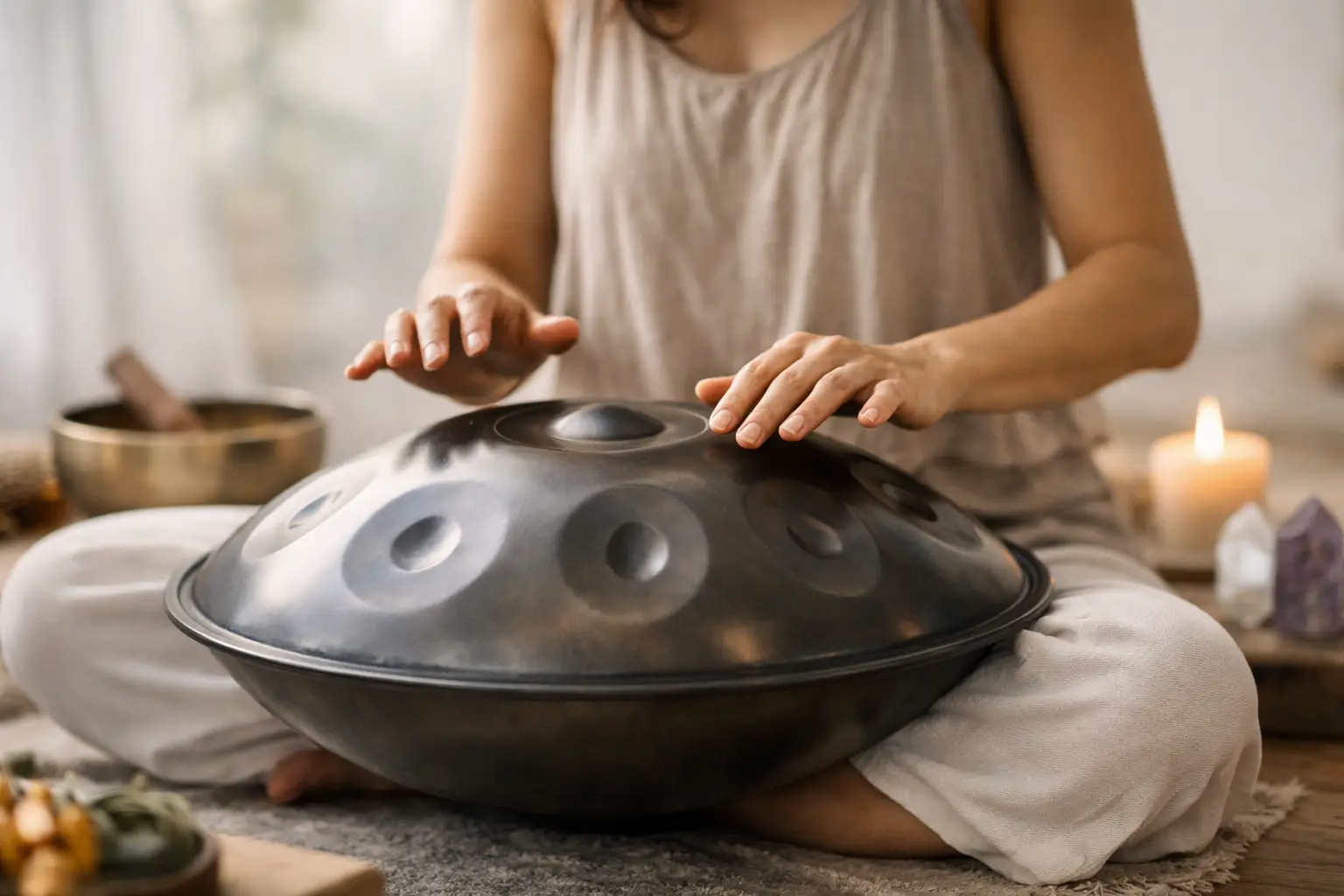
A handpan is a tuned steel instrument played with the hands and fingers. At its centre sits the ding, often the lowest and most grounding note. Around it are tone fields tuned to a particular scale. Because these notes have been selected to sit harmoniously together, a beginner can explore freely while still creating a coherent musical atmosphere.
This layout changes the relationship many people have with music-making. Rather than reading notation or worrying about a wrong chord, you can start by answering one note with another. A simple pulse on the ding can become an anchor. A higher note can offer lift. A pause can be as expressive as a phrase.
The handpan’s physical response is part of its character too. Gentle touch produces a clear, resonant voice; heavier strikes can choke the sound or introduce unwanted clatter. Learning to play softly is not a limitation. It is an invitation to listen closely. Over time, players discover that subtle changes in touch, placement and timing create far more colour than force ever could.
Resonance needs space
The most restorative handpan music is not always the slowest or quietest. It is music with room to breathe. When every moment is filled with notes, the natural decay of the instrument disappears. When phrases are allowed to settle, listeners can feel the shape of the sound and the silence around it.
This is useful whether you are playing alone or holding space for others. A meditative session may use sparse patterns and long pauses, while a yoga class might benefit from a steady, unobtrusive rhythm. A live performance can gradually build more movement and contrast. The intention should guide the playing, rather than a fixed idea of what healing music must sound like.
How to begin a handpan sound healing practice
Start with a short ritual you can return to. Place the handpan somewhere comfortable and stable, ideally on your lap or a purpose-made stand. Before playing, sit quietly for a few breaths and notice the acoustic character of the room. A tiled space will reflect sound differently from a carpeted lounge room, and an outdoor setting brings wind, birds and distant traffic into the experience.
Begin with the ding. Play it softly, then wait until the sound has nearly faded. Repeat this several times at a pace that feels unhurried. Next, add one nearby tone field after every second or third ding. You are not trying to impress anyone. You are establishing a pulse you can comfortably maintain.
Once that feels settled, create a question-and-answer phrase. Play two or three notes in the lower area of the handpan, pause, then respond with two notes higher up. Keep the phrase simple enough that you can hear how each note blends. If your attention wanders, return to the ding and begin again.
A useful practice might look like this over ten minutes: spend the first few minutes with slow single notes, move into a gentle repeating pattern, then gradually reduce the number of notes until you finish with silence. There is no need to force an emotional outcome. Let the instrument be a companion to whatever is already present.
Choosing a scale for calm, reflection or movement
No scale can guarantee a particular feeling. Musical associations are shaped by culture, memory and personal taste. Still, the scale of a handpan has a strong influence on the atmosphere it naturally encourages.
Minor scales are often chosen for introspection, depth and a more contemplative mood. They can feel earthy and cinematic, particularly when played slowly. Major scales tend to sound brighter and more open, which may suit uplifting morning practice, group sessions or music that needs a sense of warmth and possibility.
Some players are drawn to scales with an Eastern, Celtic or mystical flavour. These can be wonderfully expressive, but it is worth listening beyond the label. Ask yourself whether you would enjoy returning to those notes on an ordinary Tuesday night, not only during a special meditation. The right handpan is one that keeps calling you back to play.
The number of notes matters as well. A handpan with fewer notes can feel focused and uncluttered, making it approachable for beginners and spacious wellness work. More notes offer a larger melodic range and greater possibilities for experienced players, but can take longer to learn intuitively. There is no universal best choice – only the balance that suits your ears, hands and intentions.
Playing for others with care
Offering handpan music in a yoga class, meditation circle or one-to-one wellbeing setting requires more than beautiful notes. It calls for awareness of volume, timing and consent. Some people find sustained sound deeply settling, while others may be sensitive to volume, repetition or close proximity.
Keep the volume modest, especially indoors. The handpan carries more easily than it may seem from behind the instrument. Position yourself so participants can hear the music without feeling surrounded by it, and leave generous gaps between phrases. If you are playing during guided meditation, let the spoken guidance remain clear rather than competing with it.
It also helps to be precise about what you offer. You can say that the session is designed to support relaxation, presence or creative reflection. Avoid promising to heal conditions, release trauma or create a specific emotional result. A respectful approach protects participants and honours the real, quieter power of music.
For group work, repetition is your ally. A simple pulse gives listeners something to settle into, while small melodic changes keep the sound alive. Save more intricate playing for moments where it serves the room, not just the player. The most moving choice may be to stop completely and let a breath, a bird call or the soft hush of the space take over.
Caring for the instrument and the practice
A handpan is made for touch, but it deserves thoughtful care. Keep it dry, wipe away fingerprints after playing and store it in a quality case when travelling. Avoid leaving it in a hot car, near salt air for extended periods or in damp conditions. These habits help preserve both the finish and the clear resonance that makes the instrument so engaging.
Care also means keeping your practice honest. Some days you may play for twenty minutes and find a flowing, centred rhythm. Other days, a few scattered notes may be all that arrives. Both are part of learning. The handpan is not there to demand a performance from you. It offers a responsive surface for attention, curiosity and expression.
Whether it becomes part of your personal wind-down, a yoga offering or your own musical voice, let the relationship develop slowly. One well-listened note can be enough to begin.