

Best Native Flute Keys for Your Playing Style
Best Native Flute Keys for Your Playing Style
A flute key changes more than the notes under your fingers. It shapes the weight of the instrument in your hands, the warmth in its voice, and the emotional space it creates in a room. The best native flute keys are not simply the lowest, highest or most popular options – they are the keys that suit the way you want to play, listen and connect.
For many players, a Native American-style flute becomes a companion for quiet morning practice, meditation, songwriting or shared music-making. Choosing its key well means you are more likely to reach for it often. Rather than chasing a universal ‘best’, listen for the range that feels like your own voice.
What a flute key really tells you
When a flute is described as being in A, G, F# or D, that letter names its tonal centre. Many Native American-style flutes use a minor pentatonic scale, an arrangement of notes that sounds naturally spacious and melodic. This is one reason they are so welcoming for beginners: gentle improvisation can sound musical before you know the names of every note.
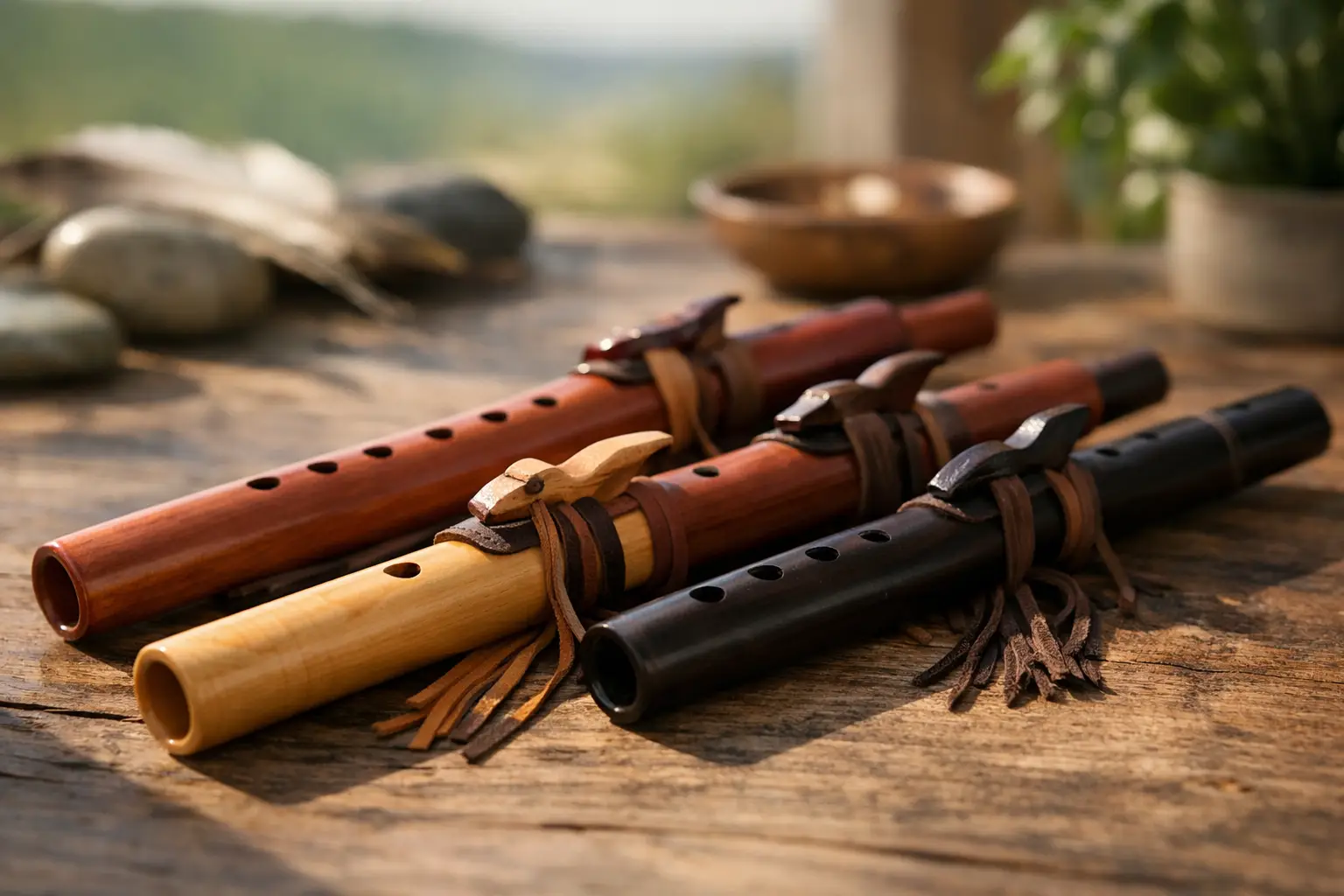
The key also affects pitch and physical dimensions. Lower-key flutes are generally longer, with larger finger holes and a deeper, rounder sound. Higher-key flutes are shorter, lighter and brighter, with a more nimble voice. Neither is inherently better. A low D can feel beautifully grounding in a sound session, while a high A may bring clear, bird-like lift to a melody.
It is worth remembering that makers may offer different tunings, scale patterns and octave ranges. Two flutes labelled as the same key can still feel distinct because of their bore, wood, voicing and craftsmanship. The key is your starting point, not the whole story.
Best native flute keys for beginners
For most new players, G and F# are excellent places to begin. They sit in a comfortable middle register: low enough to offer warmth and resonance, yet not so large that the stretch becomes frustrating. Their voices are full and calming without becoming overly dark.
A flute in G is often an especially friendly choice for adults with average-sized hands. It has a relaxed, earthy tone that works beautifully for unhurried improvisation, breathwork and reflective playing. F# is very close in feel, usually offering a little extra depth and a slightly more spacious character.
A is another strong beginner key, particularly for players with smaller hands or anyone drawn to a brighter, more immediate response. Its shorter body makes it easier to hold, carry and play for longer periods. The trade-off is that it does not have quite the same low, enveloping presence of a G or F# flute.
If you are purchasing your first flute without the chance to try several, G is often the safest all-round recommendation. Still, comfort should lead the decision. A flute that feels easy in your hands invites the steady practice through which tone, breath control and personal expression develop.
A practical note on hand stretch
Finger-hole spacing matters as much as the stated key. Lower flutes can require a wider reach, especially if you have smaller hands, reduced finger mobility or are returning to music after injury. Ask about ergonomic hole placement, offset finger holes or smaller-bore designs if reach is a concern.
There is no virtue in forcing a large instrument to work. A comfortable flute lets your shoulders soften and your breath move freely, which is where the music begins.
Lower keys for depth, calm and sound work
Players drawn to meditation, yoga, sound healing or slow, spacious performance often gravitate towards F, E, D and lower. These flutes can carry a wonderfully resonant, vocal quality. Their notes seem to settle into the body rather than simply passing through the ears.
An F flute offers a lush lower-register sound while remaining manageable for many players. It is a compelling second flute after G or F#, especially if you want more depth without a dramatic change in hand stretch.
E brings further warmth and gravity. It can be a lovely key for solo playing, recorded ambient music and intimate wellness settings where you want a tone that feels close and contemplative. For some players, however, the wider spacing begins to make an ergonomic design more important.
D is a true low voice in this family. Its sound can be broad, breathy and deeply calming, with a presence that sits beautifully alongside handpans, drones and low percussion. It also asks more from the hands and lungs. A D flute is often best chosen after trying one, or after building confidence on a mid-range key.
Low keys are not automatically more soothing. Their depth can be powerful, but a higher flute played with a soft breath can be equally tender. Think instead about the feeling you hope to create: grounded and expansive, or clear and gently uplifting.
Higher keys for brightness and portability
Keys such as A, B and C bring a lighter, more sparkling character. They are often easier to pack for travel, kinder on smaller hands and responsive at softer breath pressure. For spontaneous melodies on a bushwalk, by the water or between daily commitments, their portability is a genuine advantage.
A high flute can also cut through an ensemble more readily than a low one. If you play with handpan, guitar or other acoustic instruments, a brighter key may help your melodies remain present without needing to overblow.
The compromise is tonal weight. Higher flutes can sound sweet, clear and playful, but may not deliver the same low-frequency bloom that many people seek for restorative sound work. That is not a limitation – it is a different colour on your musical palette.
Choosing a key to play with others
If you hope to make music with other people, key choice becomes partly practical. G, F# and A are versatile keys that can sit comfortably with a range of handpans, guitars and percussion. Before choosing, consider the instruments already in your home or the musicians you regularly play with.
A handpan in D minor, for example, may pair beautifully with a flute whose notes share compatible tones, but the exact match depends on the handpan’s scale rather than its central note alone. A flute can either blend into the handpan’s calm wash of sound or offer a contrasting melodic line. Both approaches can be beautiful.
For musicians working with recorded backing tracks, check whether the track is in concert pitch and identify its key before buying. Native American-style flutes are commonly tuned to concert pitch, but it is sensible to confirm this with the maker. A small amount of tuning variation can matter when playing alongside fixed-pitch instruments such as piano.
Let your musical intention lead
The most useful question is not, ‘Which key is best?’ It is, ‘What do I want to hear when I pick this flute up?’ Your answer may be a low, steady voice for a meditation practice. It may be a comfortable G for learning freely. It may be a bright A that slips into your day as easily as a notebook.
If possible, hear recordings through good headphones, paying attention to the character that keeps drawing you back. Notice whether you respond to a flute’s dark resonance, airy tenderness or clear singing quality. Then balance that emotional pull with the realities of hand size, playing setting and the instruments around you.
At Handpans Australia, we see the most rewarding choices happen when players choose for connection rather than rules. One flute can become a deeply personal voice, and a second key later on can open an entirely new landscape of sound.
Choose the key that makes you want to take a slow breath, cover the holes and play the next note. That quiet urge to return is often the clearest sign you have found the right one.