

Why Handpans Detune and How to Protect Them
Why Handpans Detune and How to Protect Them
A handpan can feel like a small universe under your hands: one gentle touch brings out warmth, another creates a bright ringing response, and suddenly a simple pattern becomes a place to rest your mind. So when a note begins to sound flat, sharp, dull or unsettled, it can be genuinely concerning. Understanding why handpans detune helps you protect that voice without becoming anxious about every change in resonance.
The reassuring truth is that a well-made handpan is designed to handle regular playing. It is not so fragile that ordinary music-making will immediately throw it out of tune. Yet it is a carefully shaped steel instrument, and its pitch depends on a delicate relationship between tension, form and material. Heat, impact, storage conditions and, occasionally, playing habits can all influence that balance.
Why handpans detune: the science beneath the sound
Each tone field on a handpan is carefully formed and tuned to produce several connected pitches, usually a fundamental note plus higher octaves. The maker creates these notes by shaping and tensioning small areas of steel with extraordinary precision. That tension is what allows the handpan to sing.
If the steel is stretched, compressed or distorted beyond its intended range, the note can shift. Sometimes the change is only slight. A player may notice that a familiar note no longer sits comfortably with the rest of the scale, that its sustain has shortened, or that it has developed a faint metallic buzz.
Not every change is permanent. Steel responds to temperature, so a handpan that has been sitting in direct summer sun or left in a hot car may sound lower in pitch for a while. In cold conditions, it may sound a little sharper. Once the instrument has slowly returned to room temperature, its usual voice often returns as well.
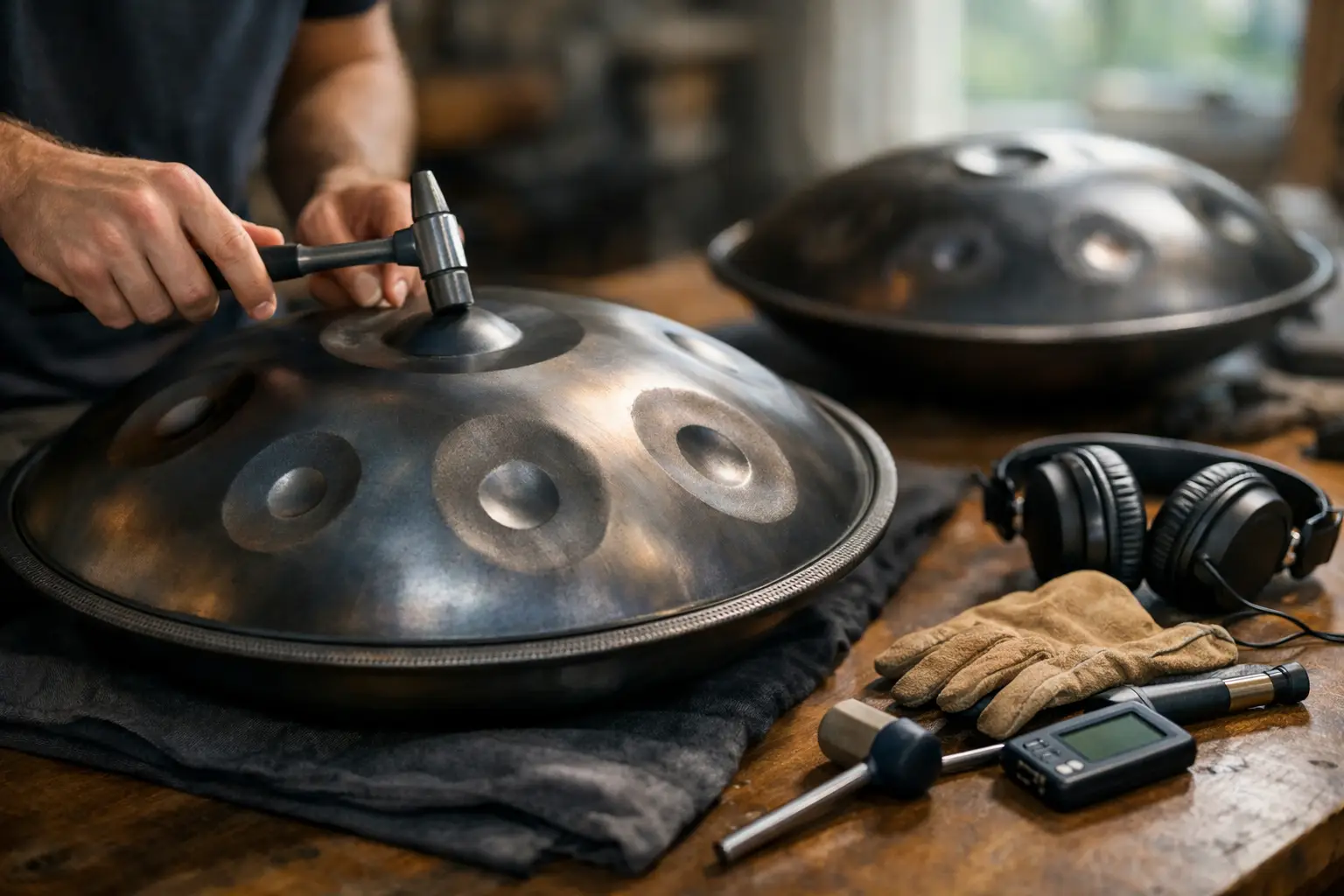
Permanent detuning is different. It tends to be caused by a physical change in the tone field or surrounding shell, usually through impact or repeated excessive force. The good news is that an experienced handpan tuner can often assess and restore a detuned instrument. The less helpful news is that this is not a job for a hammer, a tuning app and good intentions at home.
Impact is the most common cause of lasting detuning
A handpan may look solid, but it should be treated more like a finely tuned acoustic instrument than a steel drum built for rough handling. A drop, a hard knock on a concrete floor, a collision in the boot of a car or pressure from another heavy object can alter the shape of a tone field.
The risk is not limited to obvious dents. Even a small impact can affect the tension that keeps a note stable. The outer rim, known as the shoulder, is also significant. A strike or dent there may influence nearby notes and create changes that seem difficult to pinpoint by ear.
For transport, a properly fitted hard case offers the best protection, particularly if your handpan is travelling to a class, a beach gathering, a performance or a sound session. A soft bag can be useful for short, careful trips, but it will not offer the same defence against a fall or a packed car. Never place heavy gear on top of the case, and secure it so it cannot slide about while driving.
Hard playing can stress a handpan, but expressive playing is not the problem
Many new players worry that they will detune their instrument simply by practising. That should not stop you from exploring. A handpan is made to be played with the hands, and its rich dynamic range comes from both soft and more energetic touch.
The issue is repeated force rather than enthusiasm. Striking a tone field with clenched knuckles, hard objects, rings, bracelets or thick mallets can push the steel beyond what it was designed to absorb. Percussive techniques can be beautiful, but they need control. Let your hands rebound from the surface rather than forcing them into it.
A useful listening habit is to notice what produces the clearest sound with the least effort. On a responsive handpan, a relaxed tap near the right area of the tone field will often give more resonance than a heavy hit. Learning this lighter touch not only protects the instrument, it also opens up greater colour, speed and expression in your playing.
If you offer your handpan to friends, children or workshop participants, a brief demonstration can make a real difference. Show them how to tap, not slap, and ask them to remove rings or watches first. These small boundaries protect the instrument while keeping the experience welcoming.
Heat, cold and moisture affect handpan stability
Temperature changes are especially relevant in Australia and New Zealand, where an instrument might move from an air-conditioned room into strong sunlight, or from a chilly evening session into a warm car. Avoid leaving your handpan in direct sun, near a heater or inside a parked vehicle. The interior of a car can become far hotter than the air outside.
Sudden temperature changes are best avoided too. If your handpan has been in the cold, let it rest in its case for a little while before playing. This gives the steel time to acclimatise gradually and reduces condensation forming on the surface.
Moisture does not usually detune a handpan overnight, but it can lead to corrosion. Over time, rust can affect the steel’s condition, compromise its finish and create more serious maintenance concerns. Coastal air, sweaty hands, outdoor playing and humid storage all deserve a little extra care.
After playing, wipe the instrument with a clean, dry microfibre cloth. Follow the maker’s guidance on protective oils or surface care, as different steels and finishes have different needs. Keep the handpan dry, store it indoors where possible, and do not seal it away while it is damp.
The quality of the build influences tuning resilience
Handpans vary greatly in materials, shell forming, heat treatment and tuning skill. These details influence how stable an instrument remains over years of playing. A carefully built handpan from an experienced maker is generally more resilient, but no handpan is completely immune to accidental damage.
Nitrided steel, stainless steel and other treated materials each bring different qualities. Some finishes offer stronger corrosion resistance, while others may provide a particular warmth, brightness or ceramic-like character in the sound. The best choice depends on where and how you play. A player near the coast may prioritise corrosion resistance, while a performer may be drawn to a certain tonal texture.
Tuning stability also depends on the scale, note layout and the maker’s method. Lower notes require larger areas of moving steel and can feel different under the hand from high, bright tone fields. This does not make one style better than another. It simply means thoughtful construction and attentive care matter at every register.
How to tell whether your handpan is actually detuned
A handpan can sound different for many reasons. A new room, a noisy gathering, fatigue in your ears or a change in playing angle can all alter your perception. Before assuming there is a fault, let the instrument reach a comfortable room temperature and play it gently in a quiet space.
A genuinely detuned note may sound noticeably flat or sharp beside the other notes. It may have less sustain than usual, produce an unwanted rattle, or reveal a second pitch that clashes with the intended note. You might also notice that the note feels unusually stiff or unstable when played softly.
A tuning app can offer a useful reference, especially if you know the instrument’s intended scale, but it cannot replace an experienced ear. Handpan notes contain several pitches at once, and an app may react to different overtones rather than showing the full picture. Record a short, clear video of the note and contact the maker or a reputable handpan tuner for advice before taking any action.
Gentle habits that preserve your handpan’s voice
Most prevention is simple. Use clean, relaxed hands. Keep rings, watches and hard objects away from the playing surface. Carry the instrument in a quality case, protect it from extremes of heat and moisture, and give it a quick wipe after each session.
It also helps to choose where you play with care. A rug, grassed area or wooden floor is kinder than concrete if the instrument is ever set down unexpectedly. At outdoor sessions, keep the case nearby and avoid balancing the handpan on unstable chairs, railings or rocky ground.
Most of all, resist the urge to fix a questionable note yourself. Online videos can make retuning appear straightforward, but handpan tuning involves specialised tools, trained listening and a deep understanding of steel behaviour. An improvised repair can turn a small issue into a much harder one.
Your handpan does not need to live behind glass. It is there for quiet mornings, creative pauses, shared rhythms and moments when words are not quite enough. Treat it with steady care, play it with relaxed curiosity, and its resonance can remain a companion for many years.