

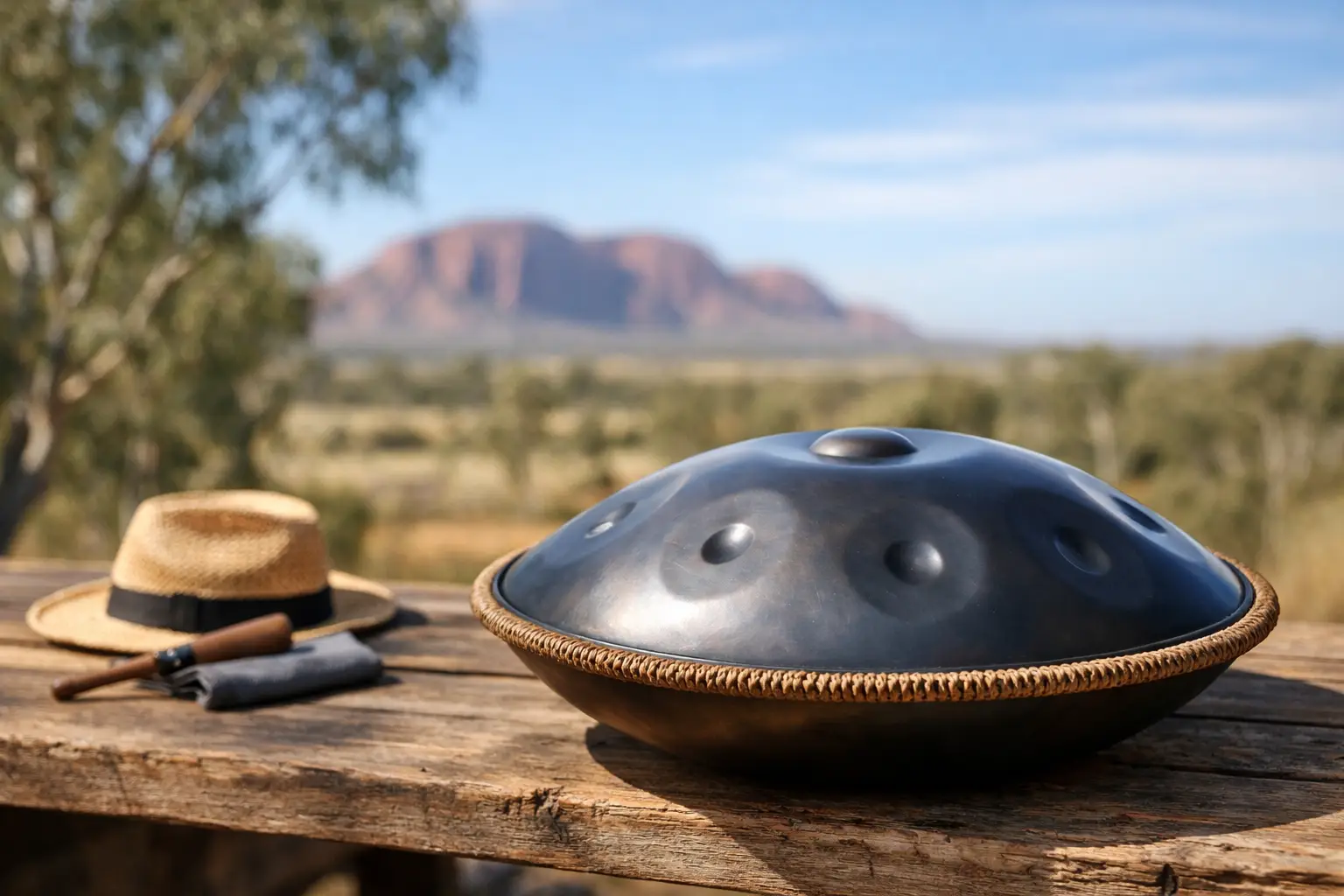
A Guide to Buying a Handpan in Australia
The first note of a handpan can feel less like hearing an instrument and more like stepping into a spacious, ringing room. But choosing one is personal. This guide to buying a handpan in Australia will help you move beyond appearances and find an instrument whose voice suits the way you want to create, rest, perform or connect.
A handpan is not simply a steel drum with a beautiful finish. Its character lives in the relationship between its scale, tuning, material, maker and your own hands. The right choice is rarely about finding the most notes or the fanciest-looking shell. It is about finding an instrument that keeps calling you back to play.
Start with the feeling you want to create
Before comparing note layouts, think about where this handpan will live in your life. Are you seeking a calm companion for quiet evenings? A melodic foundation for yoga, meditation or sound-based wellbeing sessions? A portable instrument for jamming, recording or live performance?
There is no wrong reason to begin. Handpans welcome players without formal percussion training because the notes are arranged to work harmoniously together. Even a simple, unplanned pattern can sound musical. At the same time, a well-chosen handpan offers plenty of depth for experienced musicians who want to explore rhythm, melody, dynamics and texture.
Your intention provides a useful filter. A darker, more spacious scale may suit reflective solo playing, while a brighter scale can bring energy and lift to group settings. If you expect to play with other instruments, consider the key and tonal range that will sit comfortably alongside them.
Choose a scale that speaks to you
The scale is the emotional centre of a handpan. It determines the family of notes available and strongly shapes the instrument’s mood. You do not need to understand music theory to choose one, although a little context helps.
Minor scales are especially popular because they often carry a meditative, earthy or cinematic quality. They can feel introspective without being gloomy, and their note relationships make flowing improvisation accessible. Major scales tend to sound open, sunny and uplifting. Other scale families may feel mystical, exotic, tender or rhythmically playful.
Listen carefully to recordings, preferably through decent headphones as well as your normal speakers. Do not judge a scale by a single fast performance. Hear it played slowly, with space between notes, then listen for its rhythmic potential. Ask yourself which sound you would still enjoy after twenty quiet minutes alone with it.
The central note, called the ding, anchors the instrument. Around it sit tone fields that offer melody and percussion together. A common beginner-friendly layout has eight or nine notes, including the ding. This is enough to create complete musical ideas while leaving space to learn the map of the instrument.
More notes can mean a wider melodic range and more compositional possibilities. They can also make a handpan more expensive, more complex to learn and occasionally less immediately relaxing for a newcomer. More is valuable when you know why you need it, not simply because it is available.
A note about key and frequency
Handpans are commonly tuned to a reference pitch of A=440 Hz, which is the standard used by most modern instruments. Some players prefer 432 Hz for its particular feel in personal practice or wellness settings. Neither option is inherently better. The practical question is whether you will play with other musicians, recordings or instruments that use standard concert pitch. If so, 440 Hz is usually the easier choice.
In a guide to buying a handpan in Australia, steel matters
Handpans are usually made from treated or stainless steel, and the material influences both maintenance and musical response. It is one consideration, not a shortcut to quality.
Nitrided steel is known for its warm, earthy sound and clear attack. It can develop a natural patina over time and generally benefits from regular care, particularly in humid or coastal parts of Australia. Many players love its grounded, organic voice.
Stainless steel often offers longer sustain, meaning notes ring for more time after they are struck. Its sound can feel airy, bright and expansive, making it appealing for slow, ambient playing and sound journeys. It is generally more resistant to corrosion, though it is not invincible and still needs respectful handling.
There are excellent instruments in both materials. Rather than choosing based on a label, listen for balance. Each note should speak clearly without overwhelming its neighbours. The sustain should feel musical rather than blurry, and the lower notes should remain stable when the instrument is played with confidence.
Learn the signs of considered craftsmanship
A handpan is a precision instrument. Its beauty is not only in the shape of its tone fields, but in the care taken to tune and stabilise them.
Start with the sound. A quality handpan should produce a clean fundamental note with controlled harmonics. Notes should not buzz, rattle or collapse into a metallic clang when played at normal volume. You want warmth and clarity, not perfection stripped of personality.
Then consider consistency. Recordings should demonstrate the full scale, not only a few flattering notes. If possible, hear gentle touches and firmer playing. This reveals whether the instrument offers a satisfying dynamic range. A handpan should reward finesse, but it should also tolerate the learning process.
The shell should feel solid, with tidy joins and a well-finished surface. Cosmetic marks do not automatically affect musical quality, especially on handmade instruments, but obvious damage, deep rust or poorly repaired dents deserve caution. If buying second-hand, ask about its age, previous retuning, storage conditions and any accidents.
A reputable specialist should be comfortable describing the scale, number of notes, material, tuning reference and care needs. Clear information is part of good service. Handpans Australia focuses on this category because choosing a handpan should feel supported, not like taking a gamble on an unfamiliar instrument.
Set a realistic budget, including protection
Handpans vary significantly in price. The difference reflects the time, skill and tuning stability required to create a musical steel instrument, along with the number of notes, material and finish. Be wary of unusually cheap listings that offer limited sound information, vague specifications or no clarity about tuning.
Your budget should also include a protective case. A handpan may be portable, but it is not indestructible. A fitted hard case or a strong padded case is essential if you will travel, take public transport, perform outdoors or store the instrument where it could be knocked.
It is sensible to leave room for basic care supplies too. A clean microfibre cloth and an appropriate protective oil for the steel type can help preserve the finish. Keep the handpan dry, avoid leaving it in a hot car, and never rest heavy objects on its surface. Australia’s salt air and sudden humidity can be especially unforgiving if maintenance is ignored.
Buy for your hands, not someone else’s highlight reel
A mesmerising online performance can make any handpan sound like the answer. Remember that the player, microphones, room and editing all shape what you hear. Look for demonstrations that are honest and unhurried, ideally showing the whole instrument from a close perspective.
If you can play before buying, sit with the handpan for a few minutes without trying to impress anyone. Notice whether the spacing feels comfortable and whether your hands naturally find patterns. Try soft taps with the fingers and palm, then explore the rim for percussive textures. The right instrument often feels inviting rather than demanding.
When buying online, ask practical questions before committing. Confirm what is included, how the handpan will be packed, the expected delivery process, and what support is available if there is a problem on arrival. For an instrument this sensitive, careful transport and clear communication matter.
Give your first handpan room to become yours
Your first weeks do not need to be about learning songs. Begin by finding one rhythm you enjoy, then let a few notes answer it. Play slowly enough to hear the sustain fade. Repeat a pattern until it settles into your body, then change one note and listen to where it leads.
That is the quiet gift of a well-matched handpan: it makes space for technique, certainly, but it also makes space for presence. Choose the sound that stirs something in you, care for it well, and let your own musical voice arrive one resonant note at a time.