

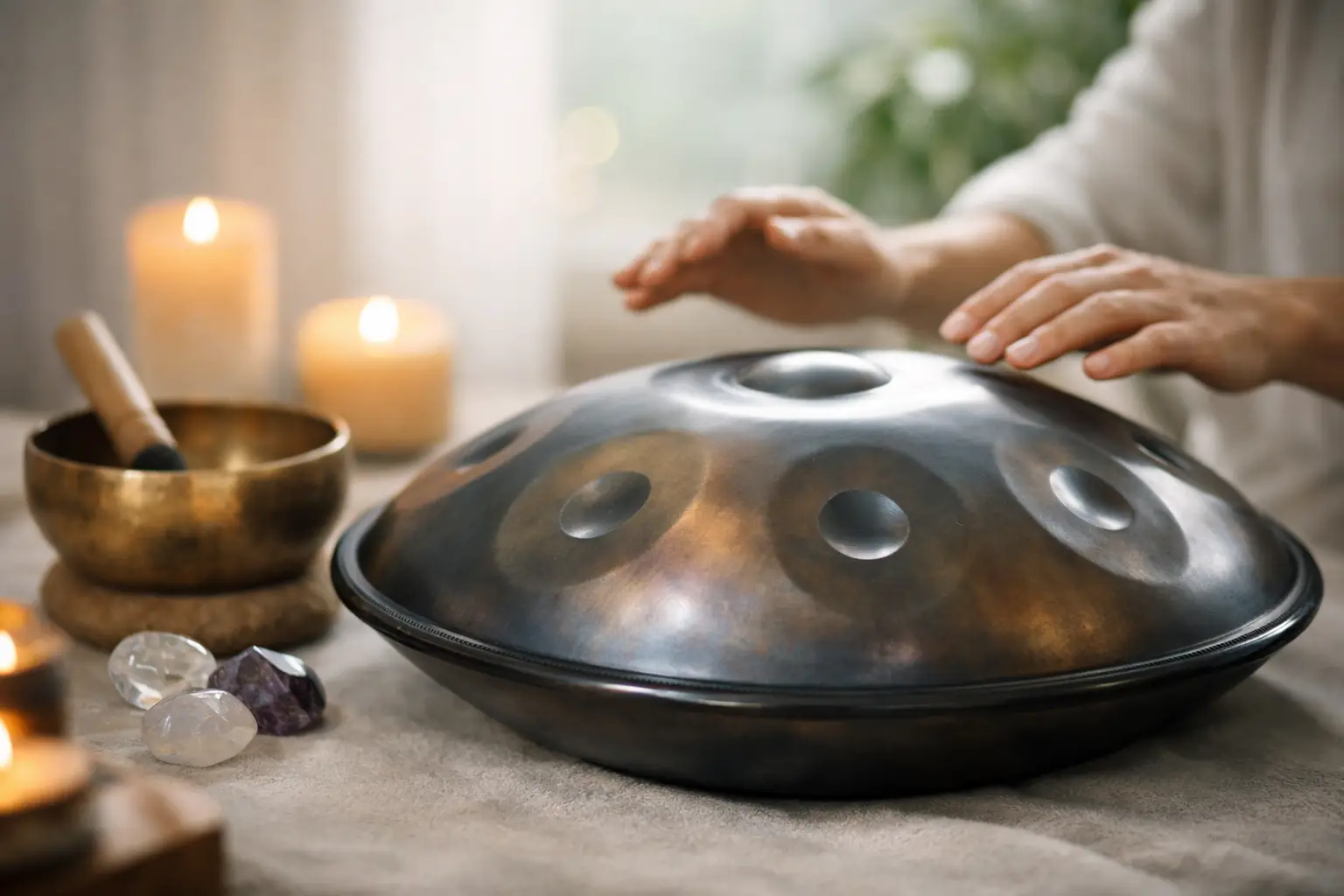
Sound Therapy and the Quiet Power of Handpans
A single handpan note does not rush to fill the room. It rises, shimmers and slowly falls away, leaving enough space for the next breath. That quality is why sound therapy has found a natural companion in instruments such as handpans, tongue drums and flutes. They invite us to listen with more attention, play without pressure and make room for a different pace.
For many people, this is not about becoming a musician or learning a performance piece. It is about creating a small ritual of sound: a few minutes before a yoga class, a gentle reset after work, or a quiet moment at home when words feel like too much. For experienced players and wellness practitioners, these instruments can also bring colour, texture and human presence to a session.
What is sound therapy?
Sound therapy is a broad term for practices that use sound, vibration, rhythm and focused listening to support relaxation, reflection or a sense of wellbeing. It can include live instruments, recorded music, singing bowls, voice, breath and environmental sound. In a guided setting, a practitioner may shape the pace, volume and tonal movement of the experience. At home, it may be as simple as playing a few intentional notes and noticing how they land.
The experience is personal. One person may find a low, resonant note grounding; another may prefer bright, spacious tones that help them feel awake and open. The setting matters too. A busy room, a rushed schedule or an instrument played too loudly can work against the calm you are hoping to create.
Sound-based practices can be a meaningful complement to rest, creative expression and established health care, but they are not a substitute for medical or mental health treatment. If you are managing ongoing pain, anxiety, trauma or another health concern, seek advice from an appropriately qualified professional. The value of a personal sound practice often lies in its simplicity: it gives you a gentle way to pause and reconnect with the present moment.
Why handpans suit sound therapy
A handpan is made for touch. Rather than striking it with sticks, you play it with your hands and fingers, drawing out notes that are both percussive and melodic. The result can feel wonderfully immediate: a soft tap gives a clear voice, while a slower touch can bring warmth and sustain.
Most handpans are tuned to a defined scale. That means the notes are designed to belong together, so beginners can explore freely without constantly worrying about wrong notes. This is especially helpful in a sound therapy context, where the aim is often presence rather than precision. You can create a simple repeating pulse, let notes ring into silence, or follow an instinctive melody as your breathing settles.
The circular layout also encourages movement around the instrument. A central ding note can provide an anchor, while the surrounding tone fields offer pathways outward. For a player, that can make improvisation feel less like a technical exercise and more like a conversation between rhythm and resonance.
That said, a handpan is not automatically the right choice for every setting. Its sustain and character can carry beautifully in a quiet studio, but a large group session may require careful placement, thoughtful volume or amplification. The scale you choose will shape the mood as well. Minor scales can feel introspective and earthy, while brighter scales may bring lift and gentle optimism. Neither is inherently more therapeutic. The right sound is the one that suits your intention and the people in the room.
The role of rhythm and repetition
Rhythm gives the listener something to return to. A slow, steady pattern can create a sense of continuity, particularly when life feels scattered. On a handpan, this may be no more complicated than alternating a low central note with two higher tones, then leaving space for the sound to fade.
Repetition does not have to mean monotony. Small variations in touch, timing and dynamics keep the music alive. Try playing more softly than feels necessary. In a quiet room, a restrained touch often reveals more detail than forceful playing: the gentle bloom of a note, the delicate rattle of a fingertip, the silence that frames the phrase.
Building a personal sound practice
You do not need a ceremonial setup or an hour of spare time to begin. Choose a time when you are unlikely to be interrupted, place the instrument securely in front of you and let your shoulders soften. Five or ten minutes can be enough.
Start by listening before you play. Notice the sounds already present: birds outside, a fan, distant traffic, your own breath. Then strike one note and allow it to finish completely. This first note is not an audition. It is an invitation to pay attention.
From there, try a simple approach: play a low note, answer it with one or two higher notes, then pause. Repeat this shape slowly. If you find a pattern you enjoy, stay with it rather than chasing something more complicated. If your mind wanders, bring your attention back to the physical feeling of your hands meeting the steel and the sound moving through the room.
A tongue drum can be an equally welcoming place to start. Its notes are clearly laid out, its voice is soft and rounded, and it often responds well to gentle mallets or fingertips. For people who prefer a melodic line over percussion, a Native American flute can offer breath-led phrasing and a deeply personal sense of expression. These instruments are different in feel, but each can support an unhurried relationship with sound.
Playing for others with care
When you play in a yoga class, meditation group or one-to-one wellbeing setting, less is often more. The instrument should support the room, not demand its attention. Begin quietly and give people time to arrive. A steady pulse may suit movement, while longer pauses can work beautifully during rest or reflection.
Watch the energy of the group rather than following a fixed musical plan. Some spaces welcome a flowing melody; others benefit from fewer notes and more silence. If you are working alongside a facilitator, agree on the purpose of the music beforehand. Is it there to mark transitions, support breathwork, accompany gentle movement or simply create atmosphere? Clear intention makes for a more considered experience.
Volume deserves particular care. Resonant instruments can feel intimate up close yet become overwhelming in a small room. Play at a level that allows people to remain connected to their own breath and body. In larger spaces, amplification may be useful, but it should preserve the instrument’s natural warmth rather than turn it into a wall of sound.
Choosing an instrument by feeling, not fashion
There is no single best handpan for sound therapy. A compact instrument can be easy to carry to classes and sessions, while a larger handpan may offer deeper low notes and a broader tonal range. A scale with fewer notes can encourage calm, focused playing; a more extended scale gives an experienced musician extra room for movement and melodic development.
Listen for the voice that you want to live with. Do you feel drawn to low, grounding tones or clear, sparkling highs? Do you want an instrument for quiet personal practice, live performance or guiding groups? These questions matter more than chasing a particular scale because someone else has called it relaxing.
At Handpans Australia, the conversation begins with that relationship: how you want the instrument to feel in your hands, where you imagine playing it and what kind of resonance keeps calling you back. A well-chosen instrument does more than sound beautiful on the first day. It keeps inviting you to sit down, listen and make something of your own.
Sound therapy is not about finding a perfect sequence of notes. Sometimes the most valuable part is the moment after you play, when the final tone has faded and the room feels a little more spacious. Let that silence be part of the music.