

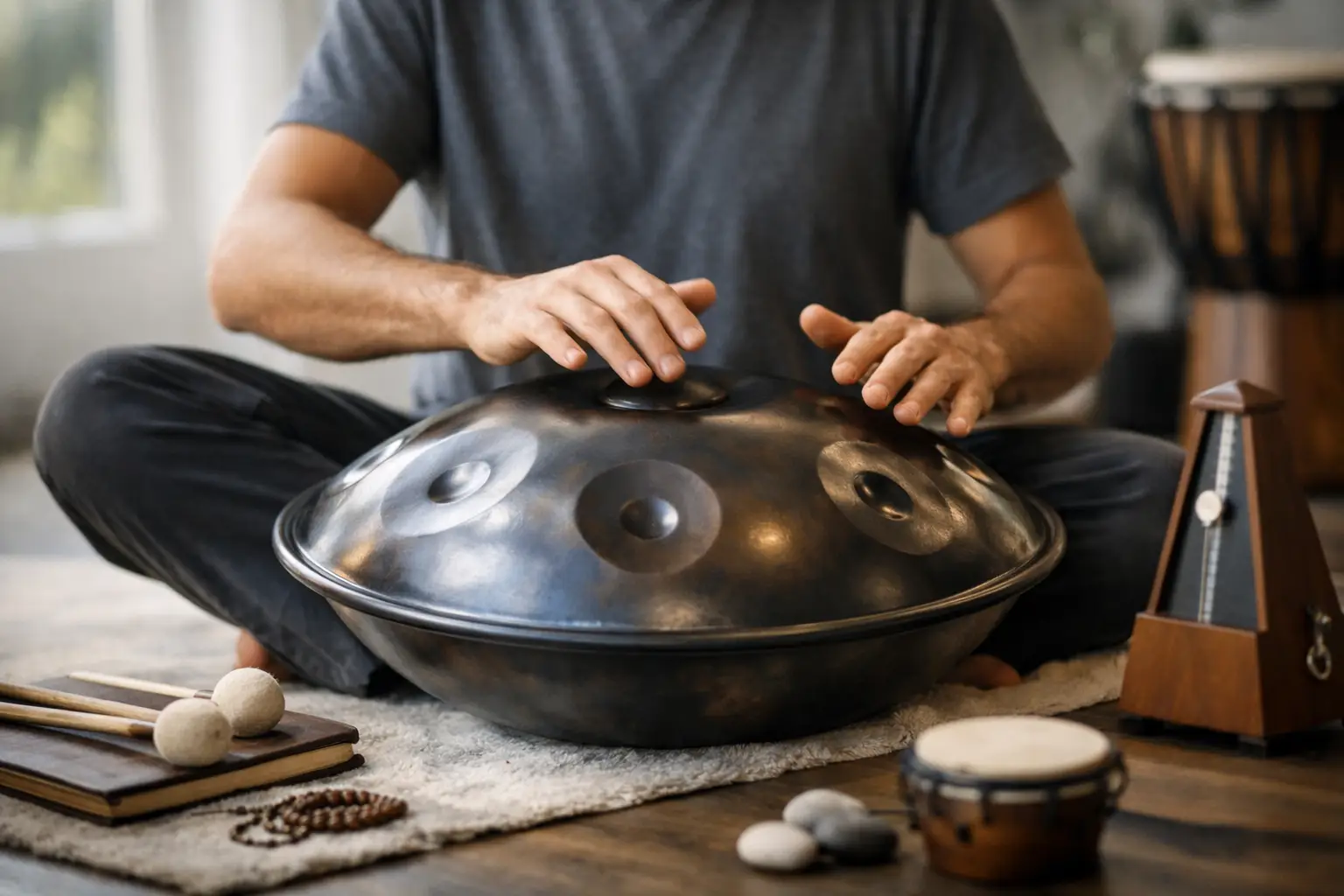
Handpan Rhythm Exercises for a Steadier Flow
Handpan Rhythm Exercises for a Steadier Flow
A handpan can make a simple pattern feel spacious and alive, but the quality that holds those beautiful notes together is rhythm. The most useful handpan rhythm exercises are not about playing faster or showing off complicated beats. They teach your hands to return to a steady pulse, so melody, resonance and silence all have somewhere to land.
For a beginner, rhythm practice can turn random tapping into music you can trust. For an experienced player, it can bring greater control to improvisation, performance and sound-based sessions. Start gently. A handpan responds best when your body is relaxed, your touch is clear and you give each note enough space to bloom.
Start with pulse, not patterns
Before adding a scale, establish the beat beneath it. Place your handpan securely on your lap or stand, sit comfortably and choose a slow tempo that feels almost too easy. Around 60 beats per minute is a lovely place to begin, although you do not need a metronome straight away.
Tap the ding, the central note, once every second. Count aloud: “one, two, three, four”. Keep the volume and tone as even as you can. This may sound basic, yet it reveals a great deal. If one strike rushes, drags or sounds noticeably harder than the next, simply notice it and continue. Rhythm grows through returning, not through judging yourself.
After a minute, let the ding become beats one and three, then play a nearby tone field on beats two and four. You now have the beginning of a grounding four-beat groove. Keep it unhurried for several minutes. The aim is to feel the pulse in your body rather than chase it with your thoughts.
Exercise: The four-step walk
Imagine walking along a quiet beach, with each footfall evenly spaced. Play ding, tone, ding, tone, counting to four as you go. Once it feels settled, change the second and fourth notes while leaving the ding in place. Your central pulse becomes an anchor, while the changing notes create colour around it.
This exercise is especially helpful for players who love improvising but find their phrases becoming scattered. There is no need to stop being expressive. Give your expression a dependable home.
Handpan rhythm exercises for both hands
A common early challenge is that one hand naturally leads while the other feels hesitant or heavy. Rather than forcing speed, use short alternating exercises that make both hands equally familiar with the instrument.
Choose one comfortable note on the left and one on the right. Play left, right, left, right, with a small and relaxed motion. Let the fingers rebound after contact. Avoid pressing into the steel or striking as though you need to pull sound from it. A well-made handpan has resonance waiting in the shell; your job is to invite it out.
When the alternation is even, add a pause after every four notes: left, right, left, right, rest. The rest matters. It helps you hear whether the final note rings cleanly and prevents the pattern becoming a blur.
Next, shift the accent without changing the tempo. Play eight alternating notes, but make only the first one slightly stronger. Repeat, then place the gentle accent on the third note. Accents create the feeling of a groove even when the notes themselves remain simple. They are also a kinder way to build musical variation than adding more and more notes.
If your non-dominant hand struggles, practise it alone for a minute on a single tone field, then return to alternation. A quieter, more controlled strike is better than a loud one that interrupts the pulse.
Learn to divide the beat
Once a steady four-beat pulse feels natural, you can explore subdivisions. These are the smaller spaces inside each beat, and they are where a handpan rhythm begins to dance.
Start by tapping the ding on each counted beat: one, two, three, four. Then play two even notes between each count, using a side tone: “one-and, two-and, three-and, four-and”. Do not speed up the entire exercise. The main pulse must stay calm while your hands fill the spaces around it.
Try this for four bars, then return to single beats for four bars. Moving between simple and divided time is a powerful listening practice. It teaches you that faster notes are not automatically more energetic. Sometimes a return to open space is what makes the rhythm breathe.
Exercise: Three notes against four
For a softer, rolling feel, count four steady beats with your voice or foot. Over those four beats, play three evenly spaced notes on a chosen tone field. Repeat the three-note phrase until it meets the beginning again.
At first, it may feel as though the notes are floating away from the beat. That is normal. This is not an exercise to force into place quickly. Listen for the point where the three-note cycle and the four-beat pulse reunite. It creates gentle tension and release, which can be beautiful in reflective playing, yoga classes or a slow live set.
Use this sparingly in free improvisation. If every phrase crosses the pulse, listeners can lose their sense of grounding. A simple groove followed by a brief rhythmic lift usually has more impact.
Build a groove with low, middle and high tones
Most handpans offer a natural sense of range: the ding provides a low centre, nearby notes offer warmth and higher tone fields bring brightness. You can shape a complete rhythm by assigning each area a role.
Keep the ding as your grounding note. Use one or two middle tones for the main response, then reserve a high note for an occasional lift at the end of a phrase. Play a four-beat cycle with ding on beat one, a middle tone on beat two, ding on beat three and another middle tone on beat four. After four repetitions, add a high note just before returning to beat one.
The high note should feel like a breath in, not a sudden interruption. If it dominates the sound, soften your touch or use it less often. On handpan, restraint often sounds more confident than constant activity.
This approach also makes improvisation less intimidating. Rather than searching for the next “right” note, you know the role each register can play. Your hands are free to respond to the moment while the rhythm remains clear.
Practise silence as part of the beat
The most resonant handpan players are comfortable leaving space. Silence is not an empty gap between ideas; it is part of the phrase, allowing the steel to shimmer and the listener to absorb what has just been played.
Create a simple two-bar rhythm. In the first bar, play four measured notes. In the second, play only the ding on beat one, then let the remaining beats rest. Repeat this cycle until the silence feels intentional rather than awkward.
You can also use a soft hand touch to gently mute a ringing tone. This is worth exploring carefully, as too much damping can make the instrument sound clipped. The choice depends on the mood you want: long resonance suits meditative soundscapes, while shorter notes can create a more percussive, rhythmic feel.
A 10-minute daily rhythm ritual
Consistency will take you further than an occasional long session. A focused 10 minutes is enough to build a genuine relationship with pulse. Spend the first two minutes on steady ding strikes, then two minutes alternating hands. Use the next three minutes to practise “one-and, two-and” subdivisions, followed by two minutes creating a low-middle-high groove. Give the final minute to a slow phrase with deliberate silence.
A metronome can be useful, particularly if you are preparing to play with other musicians. It offers honest feedback and helps separate a steady pulse from a merely familiar one. Yet it is not essential for every practice. At times, playing without one lets you listen more deeply to your breath, the decay of the notes and the emotional pace of your own music.
Record a short practice occasionally on your mobile. Do not listen only for mistakes. Notice where your timing settles, where the handpan sounds most open and which rhythms make you want to keep playing. Those moments are clues to your personal musical voice.
Rhythm is not a hurdle to clear before you become creative. It is the gentle current beneath your creativity. Return to these exercises often, and let every steady beat make a little more room for calm, connection and your own unmistakable sound.