

Handpan Scales Explained for Finding Your Sound
Handpan Scales Explained for Finding Your Sound
A handpan can feel instantly musical, even under the hands of someone who has never studied percussion. That ease is not accidental. Handpan scales explained simply: the notes are carefully chosen to belong together, so your first gentle patterns can already carry a sense of calm, movement or release. The scale is the instrument’s emotional starting point, and choosing it well matters far more than choosing the most familiar name.
What a handpan scale really is
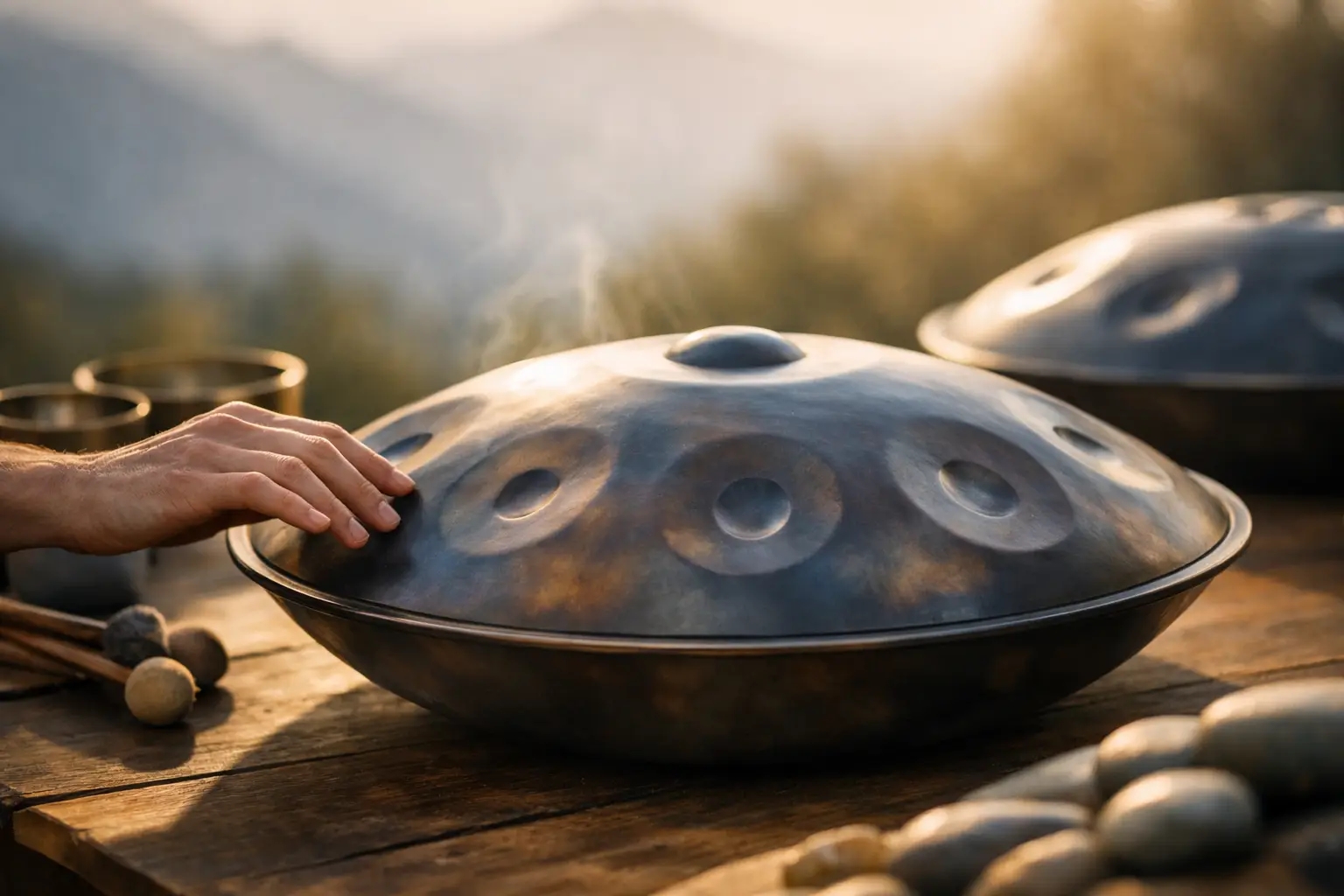
A scale is a collection of notes that work together in a particular musical family. On a handpan, those notes are arranged around a central note called the ding. Rather than facing a long row of keys or strings, you meet a circular landscape of tone fields. Each note has a place, and the layout invites melody, rhythm and harmony to appear in the same gesture.
Most handpans are tuned to a single scale. This is one reason they are so welcoming for beginners: there are fewer notes that clash, and much more room to listen, repeat a phrase and let an idea develop. You do not need to know the scale name to make music with it. But understanding its character helps you choose an instrument that continues to inspire you after the first few beautiful sounds. If you’re ready to explore the different scales and tunings available, browse our handpan collection
A scale name usually includes a root note and a mode or tonal quality. For example, D Kurd means the scale is centred around D and uses a note pattern often associated with a spacious, minor sound. The exact notes can vary between makers, especially when extra notes are added, so a scale name is a useful guide rather than a complete description.
Handpan scales explained through feeling
People often ask which handpan scale is best. The honest answer is that it depends on what you want the instrument to hold for you. A scale can support a slow personal practice, carry a yoga class, sit beautifully beside a guitar, or cut through a live ensemble. None is universally better.
Minor scales: reflective, warm and cinematic
Minor handpan scales are a natural home for introspective playing. They can feel earthy, tender, mysterious or deeply restful. This does not mean they are sad. A minor handpan can be joyful and rhythmically alive, but it often has more shadow and emotional depth than a brighter major scale.
D Kurd is among the most popular choices for good reason. Its notes offer a generous balance of low resonance, melodic possibility and satisfying chord shapes. It gives beginners plenty of safe places to explore while offering experienced players enough range for more detailed compositions. If D Kurd appeals to you, you can explore our available handpans and compare the different scales currently in our collection.
Other minor variations, such as Amara or Celtic Minor, can feel open, lyrical and meditative, though their individual note layouts shape the experience.
If you are drawn to quiet evenings, slow improvisation, sound healing or music that leaves room for reflection, a minor scale is often a strong place to begin.
Major scales: bright, open and uplifting
Major scales tend to carry more sunlight in their sound. Their intervals often feel clear, optimistic and celebratory, making them lovely for outdoor playing, group music-making and melodies that need an immediate lift.
The trade-off is not a limitation, just a different flavour. Where a minor scale may invite you to linger inside a mood, a major scale can encourage forward motion and lightness. For some players, that is exactly what makes them reach for the instrument every day. For others, a very bright scale can feel less versatile when they want to express quieter or more complex feelings.
A major handpan can be especially rewarding for educators, performers and players who enjoy making music with friends. Its welcoming character is easy for a room to respond to.
Exotic and world-inspired scales: colour and atmosphere
Some scales use intervals that sit outside the familiar major-minor sound many Western listeners expect. They may be inspired by musical traditions from around the world, or designed by makers to create a distinctive tonal atmosphere. Names such as Hijaz, Raga or Romanian Hijaz can suggest a vivid, travelling quality, with tension and resolution that feels dramatic and expressive.
These instruments can be captivating, particularly for performance, composition and ceremonial or ambient settings. They also ask you to spend time with their personality. A scale with strong character may give you a recognisable voice, yet be less flexible if you want one handpan for every mood and musical setting. Listening closely, without rushing to label a sound as easy or difficult, is the best way to know whether it feels like home.
The root note changes the instrument’s presence
Two handpans can share the same scale pattern but feel very different when their root notes differ. A lower-rooted instrument, such as D or C, generally has a deeper, rounder presence. Its bass can settle into a room and support slow, grounded playing. Lower notes are often cherished for meditation, sound-based wellbeing and solo music where resonance has space to bloom.
A higher-rooted handpan, perhaps E, F or G, can feel lighter, more immediate and more portable in a mix with other instruments. Higher pitches often speak clearly in busy environments, though they may not offer the same low physical warmth as a larger, deeper pan.
Size is part of this decision too. Lower handpans are commonly larger because the steel needs more space to produce those frequencies. If portability is a priority for travel, busking or carrying your instrument to classes, a mid-range scale can offer a practical balance. If your heart is set on deep bass, allow for a little more size and weight.
Note count: more options, or more focus?
A standard handpan may have eight or nine notes, including the ding, while extended instruments can have 10, 12 or more. More notes can bring extra octaves, richer chords and longer melodic pathways. For an experienced musician, that expanded range can be wonderfully expressive.
Yet more notes are not automatically the right upgrade. A handpan with fewer notes can feel beautifully uncluttered. It encourages repetition, touch, timing and silence – the parts of music that often create the strongest sense of connection. It is also easier for a newer player to learn the geography of the instrument and develop confidence.
Consider how you want to play. For relaxed home practice, a focused nine-note handpan may offer everything you need. For performance, recording or playing with other musicians, added notes can give you more ways to shape an arrangement. The important question is not how many notes you can buy, but how many you will enjoy returning to.
Listen for the notes between the notes
When choosing a handpan, do not only listen to a quick melodic demonstration. Notice the sustain after each strike. Does the sound fade gently or hang in the air? Listen to the low ding, the high notes and the transitions between them. Some scales feel naturally flowing when played in sequence; others reveal their magic in pauses, accents and unexpected leaps.
It also helps to imagine the setting where you will play. A long, resonant scale can be exquisite in a quiet studio but may become dense in a small group. A bright, crisp instrument may work beautifully outdoors or alongside a Native American Flute, where clarity lets each voice be heard. For a wellness session, consider whether the scale settles your own nervous system before thinking about how it may affect anyone else.
If possible, return to recordings more than once and listen at different times of day. The scale that sounds impressive in a first minute may not be the one that keeps calling you back. Often, the right handpan creates a small physical response: your shoulders drop, your breathing changes, or your hands begin quietly mapping rhythms before the instrument is even in front of you.
A simple way to choose your first scale
Start with the feeling you want to explore most often. If you are seeking calm, reflection and versatile solo playing, a mid-range minor scale such as D Kurd is a trusted starting point. If you want warmth, optimism and easy group connection, look towards a major scale. If you want an instrument with a striking voice for performance or personal ritual, spend time with the more unusual tonal families.
Then consider pitch, note count and the places you will play. A handpan is not a collection of specifications. It is a companion for your hands, your listening and your own musical identity. Give yourself permission to choose the sound that feels meaningful, even if you cannot yet explain every note. The right scale will keep offering new places to rest, play and create. Explore our collection of handpans for sale and find a scale that feels right for you.