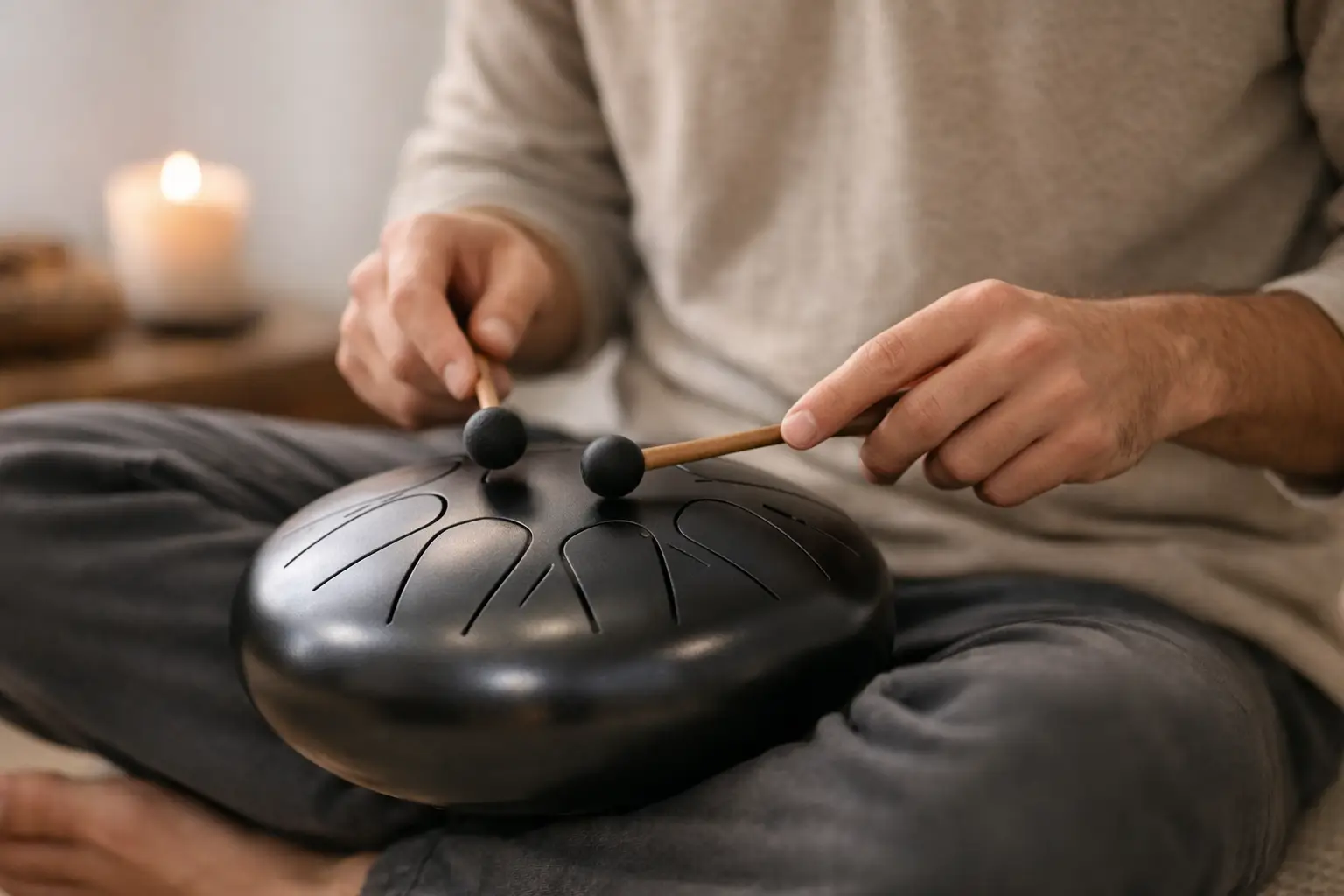
A tongue drum can meet you exactly where you are. You do not need years of lessons, a shelf of theory books or perfect timing to make something beautiful. Learning how to play tongue drum begins with a quieter skill: listening to the note bloom, fade and make space for the next one.
These compact steel instruments are wonderfully forgiving, but they still reward a relaxed touch and a little attention. Whether you are playing to settle into the evening, bringing sound into a yoga or meditation session, or building ideas for performance, the aim is not to rush towards complicated patterns. It is to let the drum teach your hands how it wants to be played.
Start by placing the tongue drum somewhere stable. A table, your lap or a stand can all work well, provided the underside of the instrument is not pressed tightly against a soft surface. The sound needs room to resonate. If you play in your lap, sit comfortably with both feet grounded and keep the drum level enough that your hands can reach each tongue without strain.
Most tongue drums can be played with mallets, fingertips or a combination of both. Mallets give a round, bell-like voice with a clear attack, making them a welcoming place for beginners. Hold each mallet lightly, rather than gripping it as though you are trying to control every note. Let the wrist stay loose and allow the mallet to rebound naturally after contact.
Strike the centre or upper area of each tongue with a gentle, confident tap. A hesitant touch can produce a thin sound, while a heavy hit may create unnecessary clatter. Think of knocking softly on a door, not hammering in a nail. Give each note a moment to ring before playing another, especially as you are getting familiar with the instrument.
Fingertips create a more intimate, percussive character. Use the padded part of your index or middle finger and lift away immediately after contact. If your fingers stay on the tongue, they mute the resonance. Finger playing often feels less precise at first, but it opens up lovely dynamic contrast once your hands settle in.
Try the same tongue with both approaches. Notice how a mallet carries a fuller, more sustained note while fingertips can feel closer and more conversational. Neither is the correct method. Your choice depends on the mood you want, the setting and the sound of your particular drum.
Tongue drums are commonly tuned to a scale in which the notes naturally sit well together. That is part of their magic. On many models, you can move between notes freely and hear pleasing combinations without having to understand chords or read notation.
Take a moment to locate the lowest and highest notes. Then find a note that feels like home – often the central or lowest tongue. Play it once, pause, then play a nearby note. Return to the first note. This simple movement away and back creates a sense of arrival, even before you know the names of any notes.
A useful first musical phrase might be three notes: home note, a higher note, then home note again. Repeat it slowly several times. Keep the gaps between notes even, then change one thing only: make the final note longer, choose a different higher note, or leave a larger pause before beginning again. These small choices are the beginnings of musical expression.
If your drum came with numbered note stickers, a scale chart or a song sheet, feel free to use them. They can be helpful when you want to learn a recognisable melody. But do not feel obliged to follow them straight away. The physical layout of the tongues can become familiar through sound and touch, much like learning the path through a favourite garden.
A common beginner habit is to keep playing because the instrument sounds so inviting. It is an understandable impulse, yet tongue drums often sound most spacious when silence has a place in the pattern. A ringing note needs time to reveal its full colour.
Play four slow beats: note, rest, note, rest. Use one tongue at first. Then choose two tongues and alternate between them. Count quietly as you play: one, two, three, four. You are not trying to be rigid. The count simply gives your hands a steady path to follow.
Once that feels comfortable, create a pulse with a lower tongue on beats one and three. Add a higher tongue on beats two and four. This gives you a gentle foundation and melody at the same time. If the rhythm becomes tangled, slow it down rather than forcing your hands to catch up.
Patterns make it easier to stop overthinking. Start with four notes and repeat them until the motion feels natural. For example, move from a low tongue to two middle tongues and then a higher tongue. Keep the same order for a minute. Repetition is not boring here – it gives your ear a chance to notice tiny shifts in resonance, timing and touch.
When the pattern feels settled, change only one note. Then return to the original version. This call-and-response approach helps you hear what each choice contributes. You may find that one variation feels bright and playful, while another lands with more calm and weight.
For a more flowing sound, alternate hands. Right, left, right, left creates a natural movement that can help you maintain an even pulse. If you are using two mallets, allow each hand to take neighbouring tongues rather than reaching awkwardly across the drum. Comfort matters more than a prescribed hand arrangement.
You can also create contrast by changing volume. Play a phrase softly, then repeat it a little more firmly. On a tongue drum, dynamics do not need to be dramatic to be effective. A subtle lift in volume can make a phrase feel as though it is opening, while a softer return can bring it back towards stillness.
Set aside five unhurried minutes with no goal beyond sound. Spend the first minute striking individual tongues and listening until each one fades. In the second minute, alternate between two notes at a steady pace. For the third, add a third note whenever it feels right.
During the fourth minute, return regularly to your home note. Let it anchor the music whenever you lose your place. In the final minute, play fewer notes than you think you need. Leave gaps. Finish on a note that feels settled, and let the final resonance disappear on its own.
This small ritual develops control without making music feel like homework. It is also a useful reset before a sound healing session, creative practice or quiet moment at home.
Improvisation is simply making choices in real time. On a well-tuned tongue drum, you already have a supportive musical landscape beneath your hands. Begin by keeping one element consistent, such as a repeating low-note pulse, while allowing the notes above it to change.
If you feel stuck, limit yourself to three tongues. Constraints can be freeing. Explore different orders, repeat a note twice, or answer a high note with a lower one. Record a short session on your mobile if you like. Listening back can reveal phrases worth returning to, and it can be encouraging to hear how much music emerged from a few minutes of play.
For meditation, slower phrases with generous space tend to support a grounded atmosphere. For a group setting or live performance, a clearer pulse and slightly stronger mallet strokes may help the sound carry. The right approach depends on your drum’s tuning, the acoustics of the room and the feeling you want to share.
Tension is the quickest way to make playing feel difficult. If your shoulders rise, your wrists stiffen or your hands begin to tire, stop for a moment. Shake out your hands, breathe and return at a slower pace. Playing with ease will produce a more open sound than playing through strain.
Keep the tongue drum clean and dry, particularly in coastal areas or humid conditions. Wipe it with a soft cloth after playing to remove fingerprints and moisture, and store it in its case when not in use. Avoid leaving it in direct sun, a hot car or a damp corner of the house. Steel responds to its environment, and a little care helps preserve both its finish and its voice.
There is no single moment when you suddenly know how to play tongue drum. There are only small discoveries: a note that makes you pause, a rhythm that settles your breath, a phrase that feels unmistakably yours. Return to the instrument often, play with curiosity, and let its resonance lead the next conversation.
