

Steel Percussion Buying Guide for Every Player
Steel Percussion Buying Guide for Every Player
A handpan can turn a quiet ten minutes on the verandah into a small, resonant ritual. A tongue drum can bring gentle melody into a yoga class without asking anyone to understand music theory first. This steel percussion buying guide is designed to help you choose the instrument that feels less like an object to own and more like a voice you will want to return to.
Steel percussion covers a wide family of instruments, but not every option delivers the same playing experience. Your best choice depends on how you hope to use it: private creative time, meditation and sound-based wellbeing, songwriting, live performance, group music-making, or simply the joy of making beautiful sounds with your hands.
Start with the feeling you want to create
Before comparing note counts or steel finishes, picture where the instrument will live in your week. Do you want a calming companion for slow, intuitive playing after work? Are you building a sound palette for breathwork, yoga or healing sessions? Or do you want rhythmic and melodic range for performing alongside other musicians?
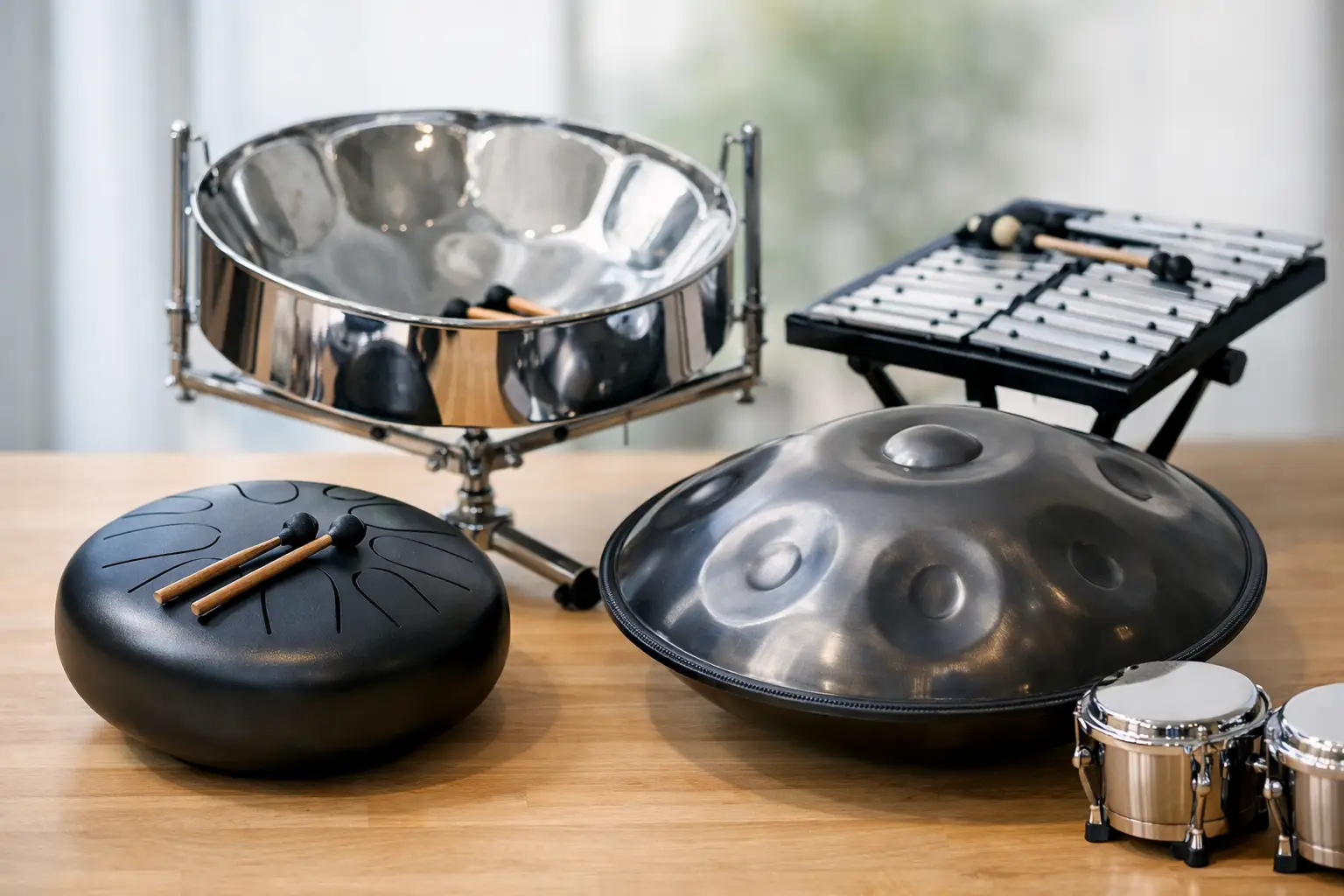
A handpan is often the most immersive choice for players drawn to expressive touch. Played with the hands, it carries warm bass notes, clear mid-range tones and bright harmonics from one sculpted steel surface. Its layout invites exploration: you can create rhythm, melody and texture without the visual complexity of a keyboard or drum kit.
A tongue drum is usually the easier, more portable entry point. Its cut tongues are tuned to a scale, producing a clean, bell-like voice that is wonderfully forgiving. Many people enjoy one for meditation, children’s music, travel or simple melodic play. It may not have the dynamic nuance or deep resonance of a quality handpan, but that simplicity is exactly its strength for some players.
Neither is automatically the better instrument. A handpan rewards time, touch and curiosity. A tongue drum makes musical moments available quickly, often at a lower price and with less concern about taking it outdoors.
Steel percussion buying guide: choose your instrument type
The first practical decision is whether you are buying for depth of expression or uncomplicated accessibility.
Handpans for resonance and musical discovery
A handpan suits players who want to spend time with an instrument and develop a personal relationship with its sound. You do not need a percussion background. The notes are arranged to work together, so gentle improvisation can sound coherent from the beginning. Over time, you can explore accents, ghost notes, rolls, slaps and rhythmic patterns that give the music its own pulse.
Handpans are also a strong fit for performers, recording artists and wellness practitioners. Their sound has enough presence to hold a room, yet enough softness to sit beneath voice, flute or other acoustic instruments. The trade-off is that they need more careful handling, a protective case and a realistic budget for quality craftsmanship.
Tongue drums for immediate, gentle melody
Tongue drums suit beginners, families, educators and anyone seeking a light, restorative musical outlet. You can play with fingers or mallets, depending on the model and the sound you prefer. Mallets bring a clearer attack; fingers create a softer, more intimate response.
They are often compact enough for a day trip, a studio shelf or a session bag. Their volume is generally more contained than a handpan’s, which can be useful in shared homes or small treatment rooms. If you want broad dynamics and a highly responsive acoustic instrument, you may eventually outgrow one. If you want calm sound with very little learning curve, it may be exactly right.
Let the scale guide your connection
The scale is the emotional landscape of your instrument. It affects whether the music feels spacious, bright, introspective, earthy or uplifting. Because handpans and tongue drums are commonly tuned so their notes belong together, choosing a scale is less about getting notes right and more about choosing a mood that keeps drawing you in.
Minor scales are popular for reflective, cinematic and meditative playing. They can feel deep without being sad, and often leave room for quiet pauses between phrases. Major scales tend to sound open and sunny, making them lovely for playful improvisation, group settings and optimistic compositions.
Some scales have distinctive cultural flavours or unusually spacious intervals. These can be beautiful for experienced players seeking a recognisable musical identity, but they are worth hearing before you commit. A scale that sounds captivating in a short recording may feel limiting if you plan to play daily.
Consider the instruments around you, too. If you hope to play with a Native American Flute, guitar, voice or another handpan, compatible keys make shared music easier. For solo playing, personal response matters more than theory. If a scale settles your nervous system or sparks a melody straight away, pay attention to that reaction.
Note count, size and range: more is not always more
A handpan with more notes gives you a wider melodic range and more compositional options. For a player writing pieces, accompanying others or seeking lower and higher registers, that added vocabulary can be rewarding. It can also make the layout more crowded and demand greater accuracy from your hands.
An instrument with a modest note count can feel wonderfully clear. There is more room to learn its rhythms, hear its sustain and become confident with the basic shapes. Beginners often assume they should buy the instrument with the greatest number of notes, but a focused layout can encourage better listening and more relaxed playing.
Size affects both sound and practicality. Larger handpans often offer lower notes and a fuller body of resonance, while smaller models can be easier to carry and may speak with a more immediate, brighter voice. Think about transport honestly. If you will carry it through airports, up apartment stairs or to weekly sessions, a beautiful instrument that is awkward to move may stay in its case too often.
Understand steel, finish and care
Quality steel percussion is sensitive by nature. It is precisely shaped and tuned to respond to touch, so care is part of ownership rather than an optional extra.
Nitrided steel is widely valued for its durability, controlled sustain and resistance to corrosion. It often has an earthy, dry character with clear definition between notes. Stainless steel commonly offers longer sustain, a more sparkling wash of overtones and strong corrosion resistance. Players who enjoy slow, atmospheric soundscapes may be drawn to that lingering bloom. Preferences are personal, and the maker’s tuning quality matters at least as much as the steel type.
Whatever you choose, keep the instrument dry, clean it with a suitable soft cloth and store it in its case when not in use. Avoid leaving a handpan in a hot car, beside salt air or in a damp shed. Do not strike it with sticks unless it is specifically made for that purpose. Careful hands preserve both the finish and the tuning.
Listen beyond the first beautiful note
Sound samples are useful, but listen with a little patience. Notice whether the centre note is full and stable, whether surrounding notes remain distinct when played in sequence, and whether the sustain feels musical rather than cluttered. On a handpan, try to hear both quiet touch and more energetic playing. A great instrument should retain character across different dynamics.
Also consider what recordings cannot fully reveal: how it feels under your fingertips, how balanced it is on your lap, and whether its voice moves you in person. If you can play before buying, take your time. If you are buying online, choose a specialist source that can explain the scale, material, tuning and intended playing style clearly rather than treating these instruments as a novelty item.
Set a budget that includes the whole experience
The purchase price is only one part of bringing a steel instrument into your life. For a handpan, allow for a well-fitted hard case or protective bag, basic cleaning supplies and, if needed, insurance for travel or performance. A cheaper instrument that is poorly tuned or inadequately protected can become frustrating quickly.
Tongue drums offer a more approachable price point, particularly for those who are still discovering whether steel melody percussion suits their practice. A quality model can remain deeply satisfying for years, especially when chosen for its scale rather than simply its appearance.
At Handpans Australia, the aim is not to push every player towards the biggest or most complex instrument. It is to help you find the sound that meets you where you are, then leaves room for you to grow.
Give yourself permission to choose with your ears and your hands, not just a specification sheet. The right steel percussion instrument will invite you to sit down, take a breath and make one more sound.