

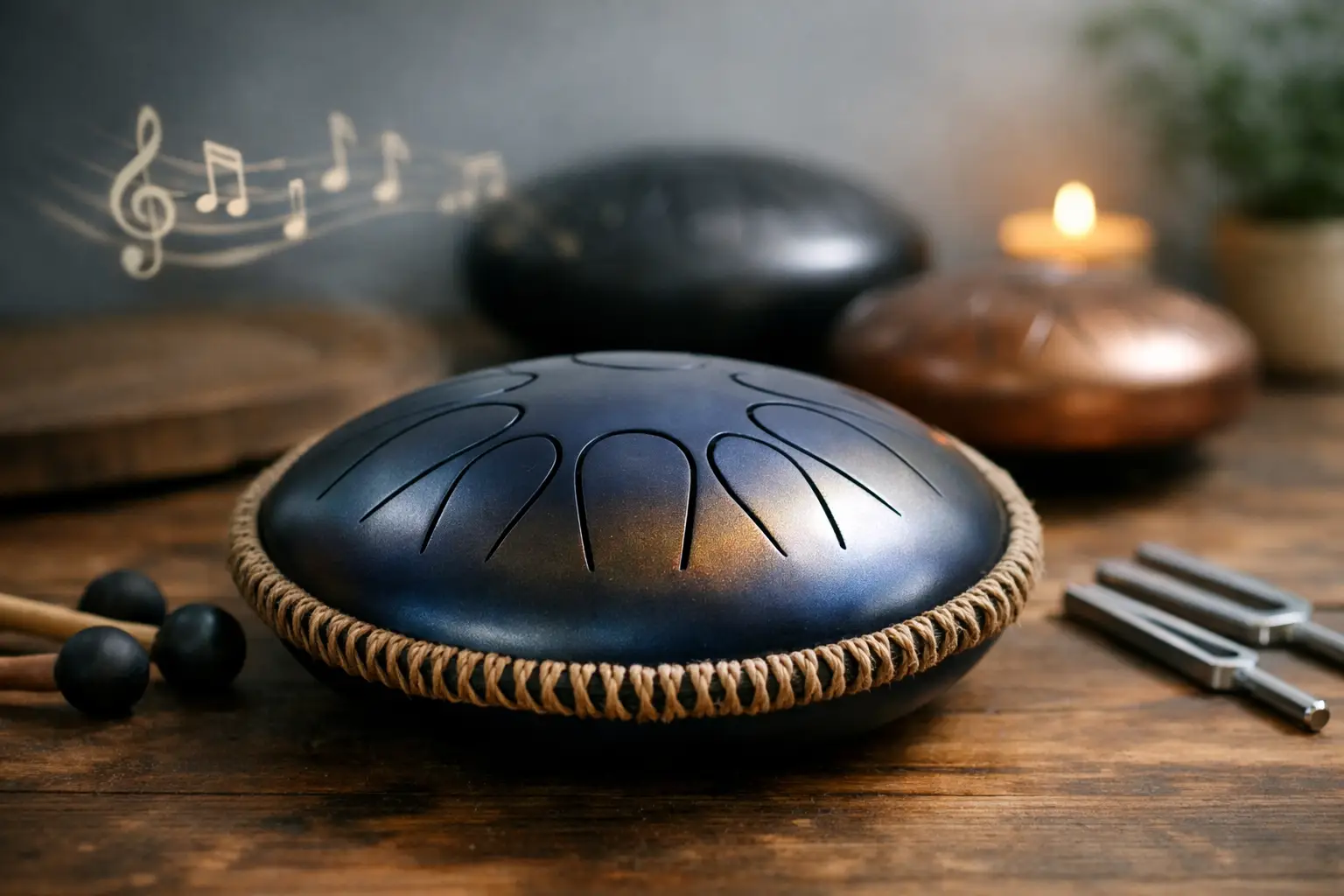
Tongue Drum Scale Guide for Finding Your Sound
Tongue Drum Scale Guide: Find Your Perfect Sound
A tongue drum can feel wonderfully forgiving from the first tap, but its scale quietly shapes every phrase you create. This tongue drum scale guide will help you hear beyond labels and choose an instrument whose voice suits your own rhythms – whether that means gentle solo playing on the verandah, a yoga class, a sound-based wellbeing session, or a melodic layer in live performance.
Unlike a piano, where every key is available at once, a tongue drum presents a carefully selected family of notes. That limitation is part of its charm. The notes are designed to sit together, so even a player with no music theory can make music that feels settled, expressive and complete.
What a tongue drum scale actually means
A scale is the set of notes tuned into your tongue drum. Each tongue, or cut-out section of the steel, produces one note when struck with a mallet or fingertips. The relationship between those notes determines the instrument’s emotional colour, its melodic possibilities and how easily it blends with other instruments.
You may see a tongue drum described by its key and scale name, such as C major, A minor, D Kurd or C Akebono. The letter tells you the tonal centre, often called the root note. The scale name tells you which intervals have been chosen around it. Two drums with the same root note can feel entirely different if they use different scales.
This is why choosing a scale is not simply a technical decision. It is a decision about the musical spaces you want to inhabit. Some scales lean bright and open. Others carry a more reflective, earthy or mysterious quality. Neither is better. The right choice depends on what makes you want to sit down and play.
Tongue drum scale guide: the main scale families
Major scales for brightness and familiar melody
Major scales tend to sound clear, uplifting and recognisable to Western ears. A C major tongue drum, for example, can suit simple songs, playful melodic exploration and group music-making. If you enjoy creating tunes that feel sunny, resolved and easy to share, a major scale can be a natural starting point.
The trade-off is that major scales can sound more musically direct than atmospheric. That is ideal for some players, particularly educators, families and performers who want an immediately approachable sound. For a player seeking a more spacious, meditative mood, a minor or modal scale may feel more compelling.
Minor scales for depth and reflection
Minor scales are often chosen for their warm, contemplative character. They can hold sadness, tenderness and stillness without becoming heavy. A minor tongue drum can be especially inviting for personal practice, slow improvisation and moments when you want to follow feeling rather than a familiar song structure.
Minor does not mean gloomy. On a well-tuned steel tongue drum, the sustain and soft attack can make minor notes feel deeply calming. They leave room for pauses, repetition and gentle rhythmic patterns, which is one reason they are popular in meditation and wellbeing settings.
Pentatonic scales for effortless flow
Pentatonic means five-note. These scales remove some of the notes that can create tension, leaving a compact palette that is exceptionally easy to improvise with. A pentatonic tongue drum is a lovely option for beginners, children, and anyone who wants to play without second-guessing each note.
Because the notes work so naturally together, pentatonic scales invite relaxed exploration. You can repeat a small motif, move around the drum at random, or build a steady pulse underneath a melody. Their simplicity is not a limitation. Skilled players often appreciate the clarity and freedom that fewer notes can bring.
Modal and world-inspired scales for atmosphere
Scales such as Kurd, Celtic, Akebono, Hijaz and other modal variations offer colours that sit outside straightforward major and minor territory. They are often associated with spacious, ancient, Eastern-inspired or cinematic moods, though every player will hear and use them differently.
Kurd scales are widely loved in the handpan and tongue drum world for their emotional range. They can feel gentle and introspective, yet still support rhythmic movement and expressive melodies. Akebono scales often have a delicate, suspended quality, while scales containing more dramatic intervals can create a stronger sense of mystery or tension.
These options can be particularly rewarding if you are drawn to music for movement, sound journeys or creative performance. They may be less suited to playing well-known songs exactly as written, but they offer a distinct voice that does not need to sound like anything else.
Start with the feeling, then consider the key
Players sometimes get caught up in finding the objectively best key. There is no such key. The key matters most when you intend to play alongside other instruments, recorded music or singers. If you are playing alone, the scale character and pitch range will usually matter more than whether the root is C, D, F or A.
Lower-pitched drums often sound rounder and more grounding. Their notes can bloom with a slower, fuller resonance, which many players enjoy for quiet home practice, yoga and restorative settings. Higher-pitched drums can feel brighter, lighter and more agile. They may carry well in a group and can be easier to hear in a lively room.
If you already play guitar, flute, handpan or another melodic instrument, choosing a compatible key can make collaboration more comfortable. A tongue drum in D minor, for instance, may sit beautifully beside instruments and songs in related keys. But compatibility is more than matching the letter on the label. Scale notes, register, volume and your playing approach all influence whether two instruments truly blend.
How many notes do you need?
Tongue drums are available with different note counts, and more notes do not automatically mean a better instrument. An eight-note drum is often beautifully focused. Its layout is easy to learn, its musical choices are clear, and it encourages the player to make the most of rhythm, touch and silence.
A drum with 11, 13 or more notes gives you a wider melodic range and more opportunities to create contrasting sections in a piece. This can be valuable for experienced musicians, performers and players who want to write more developed compositions. It can also take a little longer to become familiar with the layout.
For a first instrument, a smaller note set is often a gift rather than a compromise. You can develop confidence quickly and hear how rhythm changes the same few notes. If you know you are a melody-focused player who enjoys learning tunes, a larger range may be worth considering from the outset.
Match the scale to where you will play
A scale that feels perfect in a quiet bedroom may serve a different purpose in a group session or on stage. Think about the moments you want your tongue drum to support.
For meditation, breathwork or gentle sound-based wellbeing work, many players prefer scales with a calm, cohesive character and a lower or mid-range voice. Pentatonic, minor and soft modal scales are common choices because they make it easy to sustain a peaceful musical thread. The instrument can support a settling atmosphere, but it does not need to carry the entire session. Space is part of the sound.
For singing, songwriting or playing with friends, a major or familiar minor scale may be more practical. These scales can make it easier to locate chords and melodies that others recognise. If you want to use your tongue drum as a melodic percussion layer beside a handpan, choose a scale that complements rather than duplicates the handpan’s note set. A little contrast can create a richer conversation between the instruments.
For solo creativity, trust the sounds that make you pause. Listen to recordings where possible, preferably with headphones as well as through your mobile speaker. Notice whether you are drawn to bright lift, dark warmth, floating ambiguity or a rhythmic, earthy pulse. Your response is useful information.
A simple way to choose without overthinking it
Begin by narrowing your choice to two or three sound worlds. Perhaps you want an uplifting major scale, a restful minor scale, or a more unusual modal voice. From there, consider pitch, note count and whether you will regularly play with other musicians.
Do not choose a scale solely because it is described as healing, beginner-friendly or popular. Those terms can point you in a helpful direction, but they cannot replace your own ears. A tongue drum becomes personal through repetition: the patterns you return to, the tempos that calm you, and the notes that seem to answer back when you need a moment of connection.
At Handpans Australia, the aim is not to make every player sound the same. It is to help you find an instrument that invites you back, day after day. Choose the scale that makes your hands curious. The rest of your musical language can grow from there.