

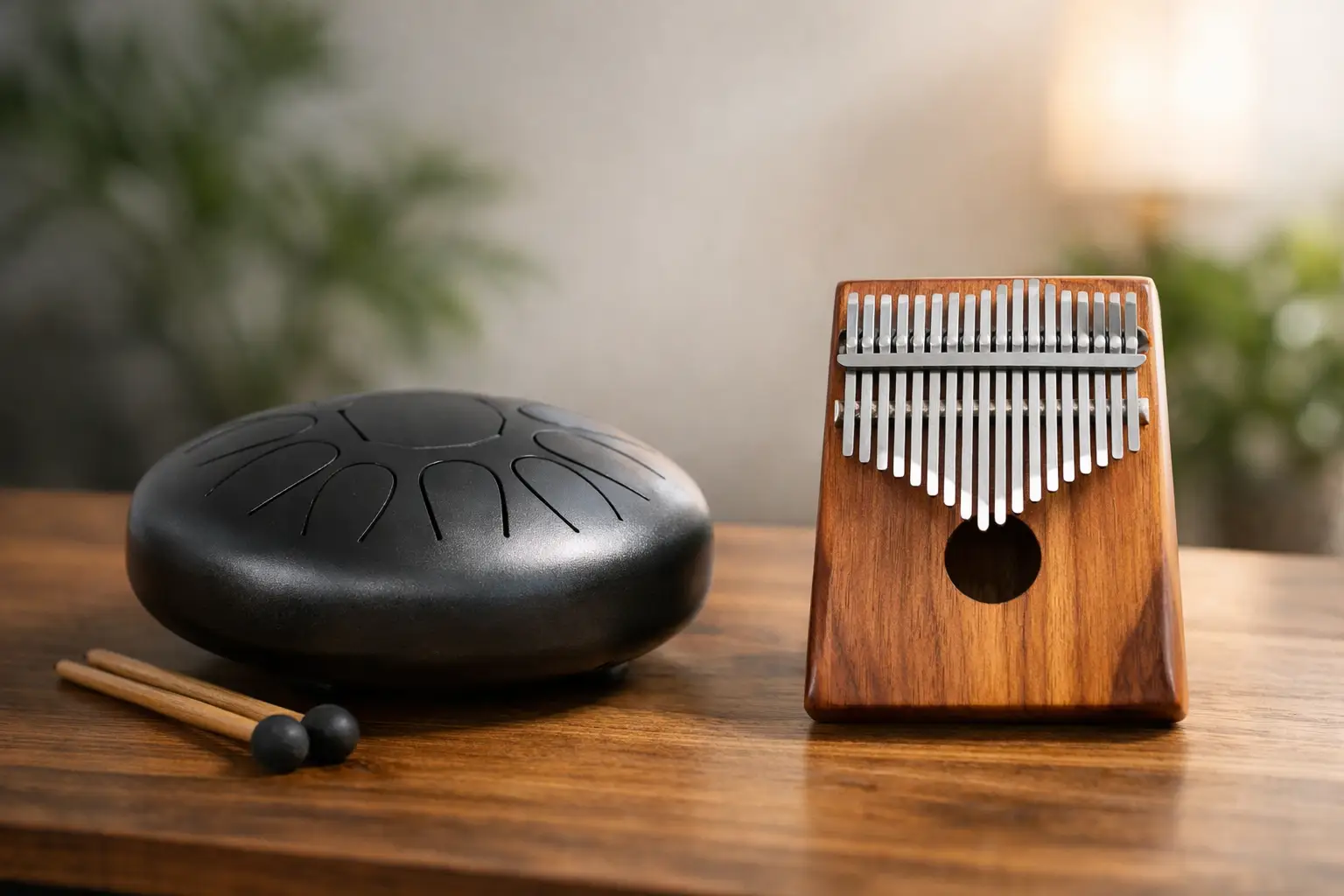
Tongue Drum Versus Kalimba: Which Suits You?
Tongue Drum vs Kalimba: Which Is Right for You?
A tongue drum versus kalimba comparison is really a choice between two very different kinds of musical intimacy. One surrounds you with rounded, resonant steel tones; the other places a bright, delicate melody directly beneath your thumbs. Both are approachable, portable and wonderfully suited to improvisation, but the feeling they create in a room – and in your hands – is distinct.
For a quiet creative practice, a meditation space, a classroom or a live acoustic set, either instrument can become a faithful companion. The better choice depends less on which is ‘easier’ and more on the sound you want to return to.
Tongue drum versus kalimba: the essential difference
A tongue drum is a tuned steel percussion instrument. Its notes are formed by cut-out tongues in the metal surface, which are struck with fingers or soft mallets. Most are made in a particular scale, so the notes naturally work together. This makes it possible to create flowing patterns without needing to stop and calculate which note comes next.
A kalimba, sometimes called a thumb piano, produces sound from metal tines fixed to a wooden board or hollow box. You pluck those tines with your thumbs, creating a clear, bell-like voice. Kalimbas also come in tuned scales, although their layout often asks you to become familiar with a pattern that spreads out from the centre rather than moving simply from low to high.
The difference is immediate when you play them. A tongue drum feels percussive, spacious and grounding. A kalimba feels nimble, intimate and melodic. Neither is a lesser version of the other. They invite different musical gestures.
Sound: warm steel resonance or bright thumb-picked notes?
Tongue drums have a soft attack followed by a lingering, rounded sustain. Depending on their size, material and tuning, they can sound earthy and deep or crisp and celestial. The notes tend to blend into one another beautifully, giving even simple playing a calm, immersive character.
That resonance makes a tongue drum particularly appealing for slow improvisation, yoga, meditation and sound-based wellbeing sessions. A single note can hang gently in the air, leaving room for breath and silence. Played with mallets, it can offer a fuller, more projected sound for a small group or performance setting.
The kalimba’s voice is more immediate and sparkling. Each tine has a defined pluck, often with a subtle metallic shimmer. Notes generally fade sooner than a tongue drum’s steel resonance, so melodies can feel more articulated and rhythmic. This is part of the charm: the kalimba can sound like a tiny music box, a gentle harp or a set of bright bells, all held in your hands.
If you are drawn to low, meditative tones that fill a space, a tongue drum is likely to feel more satisfying. If you love detailed melodies, crisp plucked textures and the closeness of an instrument played near your chest, the kalimba may speak more directly to you.
Volume and presence in a room
A tongue drum is usually the stronger choice when you want your sound to be heard beyond your immediate seat. Larger drums carry more body and lower frequencies, while smaller models remain beautifully portable without becoming silent. You can play softly with fingertips or build gentle dynamics with mallets.
A kalimba is naturally quieter. It is ideal for personal practice, recording close to a microphone, bedtime playing or calm moments where you do not want to dominate the room. In a noisier environment, though, its subtle voice can be lost unless amplified.
Which instrument is easier to learn?
Both instruments welcome beginners, especially when they are tuned to a carefully chosen scale. You do not need formal music theory to make something that sounds musical. Still, they offer ease in different ways.
A tongue drum is often the more intuitive starting point for someone who wants to relax into sound straight away. The notes are laid out visibly across the top, and a player can strike one tongue at a time, alternate hands or repeat a simple rhythm. Because the scale is already harmonious, accidental combinations often sound pleasing rather than wrong.
This can be deeply reassuring for adults returning to music after years away from it, or for anyone who feels they are ‘not musical’. A simple pulse on one or two notes can become a meditative practice. From there, you can gradually add patterns, pauses, accents and melodic phrases.
A kalimba also has a gentle learning curve, but its layout takes a little more patience. The tines are usually arranged with lower notes near the centre and higher notes moving outward on both sides. That design is efficient once your thumbs understand it, yet it can feel less obvious at first than the circular layout of a tongue drum.
For players who enjoy learning recognisable songs, the kalimba has a particular advantage. Its plucked notes are well suited to clear melodies, and many simple arrangements can be played with repeating thumb patterns. It rewards a little focused practice with lovely, detailed results.
Feel, technique and musical expression
Playing a tongue drum can feel wonderfully physical. Your hands move above the instrument, tapping, brushing and responding to the resonance beneath your fingers. Fingertips produce a warm, direct sound, while mallets create more volume and a softer rounded attack. There is room to explore rhythm as much as melody.
This makes the tongue drum a natural fit for people who are attracted to handpan music but want a smaller, more accessible steel instrument. It shares some of the handpan’s inviting quality: you can sit with it, follow your ear and let a phrase emerge without forcing it.
The kalimba creates a different kind of connection. It is held in both hands, with thumbs doing most of the work. That close contact can feel private and comforting, almost like humming a melody to yourself. Some players add subtle vibrato by moving the instrument against a surface or by using a kalimba with resonating features, giving individual notes a wavering, singing quality.
There are practical considerations too. Players with sensitive thumbs may need time to build comfort on a kalimba, especially during longer sessions. Tongue drums are generally easier on the hands, although mallet technique and posture still matter. Conversely, a kalimba may be easier to hold while travelling, sitting on a train or playing in a small lounge room.
Portability, care and everyday use
A kalimba is hard to beat for compactness. Many fit comfortably into a small bag and weigh very little. It is an easy instrument to bring along for a weekend away, a quiet break at work or a spontaneous melody outdoors.
Tongue drums are still very portable, particularly smaller models, but they are heavier and need more room. They are best carried in a fitted bag or case to protect the finish and prevent knocks. Like other steel instruments, they should be kept dry and cared for according to their material and coating. A quality tongue drum deserves the same mindful handling as any resonant instrument.
Tuning is another point of difference. Kalimba tines can often be adjusted with a tuning hammer, although this needs a careful ear and a little patience. Tongue drums are not designed for casual retuning. Choose a scale you genuinely love from the start, because it will shape the moods, melodies and musical partnerships available to you.
Choosing the right scale matters more than choosing the ‘best’ instrument
Whether you choose steel or tines, the scale will influence your experience every time you play. Major scales tend to feel open, bright and uplifting. Minor scales can feel reflective, spacious or quietly emotional. Pentatonic tunings are especially friendly for free playing because their notes blend with very little effort.
Think about where the instrument will live in your life. For personal calm, a lower-toned tongue drum in a soothing scale can become a beautiful daily ritual. For melodic exploration on the couch, while travelling or alongside a favourite song, a kalimba may offer exactly the right amount of detail and sparkle.
At Handpans Australia, the most meaningful choice is never only about specifications. It is about the sound that makes you pause, listen and want to play one more phrase.
If possible, let your ear lead before your head does. Imagine the instrument in your own hands: the room you will play in, the pace of your breathing, the kind of sound you hope to make when words are not needed. The right instrument is often the one that invites you back tomorrow.