

What Makes a Handpan Instrument So Captivating?
What Makes a Handpan Instrument So Captivating?
A handpan instrument can change the mood of a room with the first gentle strike. Notes bloom rather than simply sound, carrying a warm metallic resonance that invites you to slow down and listen. For some players, that is the beginning of a personal creative ritual. For others, it becomes a voice on stage, in a yoga class, or alongside other acoustic instruments.
Its appeal is not only in the sound. A handpan welcomes musical exploration without demanding years of formal theory before the experience becomes rewarding. You can sit with it for ten quiet minutes, follow a simple pulse, and find phrases that feel surprisingly complete. Yet the same instrument has enough depth to keep experienced percussionists and composers curious for years.
What is a handpan instrument?
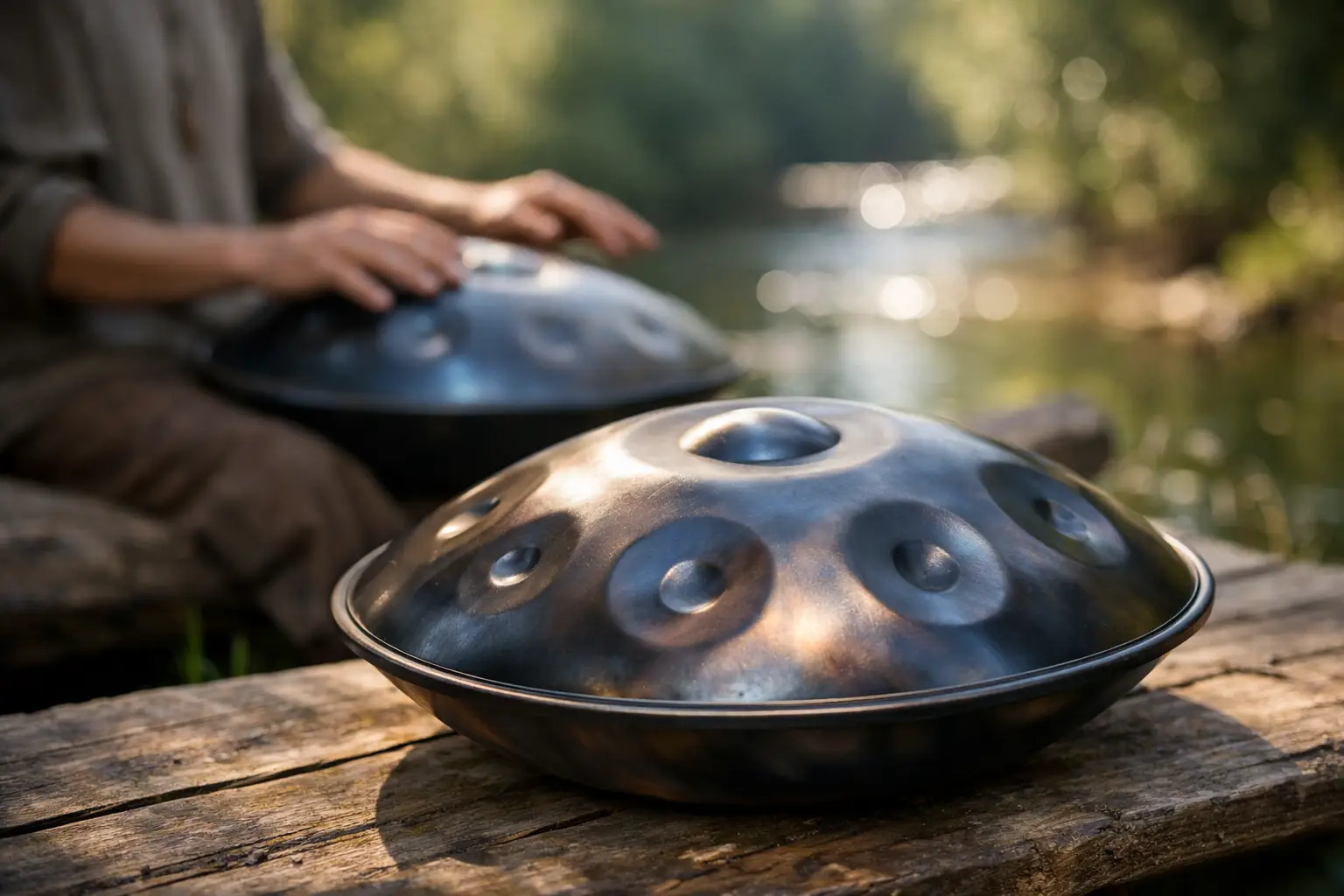
A handpan is a tuned steel instrument played primarily with the hands and fingers. Its rounded, UFO-like form contains a central note, often called the ding, surrounded by tone fields that produce a set of carefully chosen notes. Each field can carry more than one pitch, so a light, well-placed touch may reveal a bright fundamental note, a higher harmonic, or a soft percussive texture.
The modern handpan belongs to a broader family of melodic steel percussion instruments. It is related in spirit to the steel pan, but it has its own playing technique, shape and intimate character. Rather than standing over a large drum, players commonly place a handpan on their lap, a stand, or a soft surface that allows the shell to resonate freely.
Most handpans are built around a particular scale. This is one reason they feel approachable: the notes are selected to work harmoniously together. You are free to improvise, repeat a motif, or let your hands wander without constantly worrying that a note will clash.
That does not mean every handpan sounds the same. Far from it. Scale choice, note layout, steel treatment, tuning, maker skill and your own touch all shape the instrument’s personality.
Why the sound reaches people so deeply
A handpan has a rare balance of melody, rhythm and resonance. One hand can hold a steady beat while the other traces a melodic line. A single note can be crisp and bell-like, while the space after it feels spacious and lingering. That blend makes the instrument feel both grounding and expressive.
For a beginner, the immediate pleasure often comes from being able to create a musical atmosphere without reading a score. There is room to play slowly, make mistakes, listen again and turn a simple pattern into something personal. The instrument does not rush you.
For more experienced musicians, the attraction is often in the detail. Dynamics matter. Where the finger lands matters. The angle, rebound and weight of a strike can bring out a clean tone, a muted tap, a slap-like accent or a shimmering harmonic. Handpans reward close listening as much as they reward technique.
This is why they work beautifully in different settings. A player may use one for quiet evening practice, reflective songwriting, meditation sessions, live looping, small ensemble work or a performance that needs an organic, memorable texture. In wellness spaces, the sound can help create a calm and attentive environment, though the instrument is not a substitute for clinical care or therapeutic support.
The role of rhythm
People sometimes hear a handpan and focus only on its floating melody. Rhythm is just as central. The shell itself offers a palette of gentle percussion: taps around the rim, low pulses from the centre, muted strokes and pauses that create movement without clutter.
You do not need to play fast to sound musical. In fact, many compelling handpan pieces rely on a patient pulse and a few well-chosen notes. A slower approach gives the resonance room to breathe and helps you hear how one phrase leads naturally into the next.
Choosing a handpan instrument that suits you
The best handpan is not automatically the one with the most notes, the deepest bass or the most elaborate finish. It is the one that makes you want to sit down and play. Your musical goals, listening preferences and practical needs should guide the choice.
Start with the scale and mood
The scale is usually the most meaningful place to begin. Minor scales are widely loved for their reflective, earthy and cinematic mood. They can feel calm, mysterious or emotionally rich without being difficult to play. Major scales often bring a brighter, more open character that suits uplifting melodies and communal music-making.
There are also scales with distinctive cultural or modal flavours, offering sounds that may feel meditative, expansive or rhythmically playful. If you are drawn to music that creates stillness, listen for a scale that feels settled when you repeat a few notes. If you want to sing, jam or compose with others, consider which tonal centre will fit the music you already enjoy.
There is no universal “healing scale” or one correct choice for meditation. Personal response matters most. The right scale is often the one that makes your shoulders drop and your imagination switch on.
Consider note count and range
A handpan with fewer notes can be wonderfully focused. It offers a clear musical world and leaves room to learn touch, timing and rhythm. For many first-time players, this simplicity is a strength rather than a limitation.
More notes provide a wider melodic range and greater compositional possibility. They can suit players who want bass movement, extended melodies or more harmonic colour. The trade-off is that a larger note count may require more familiarity with the layout and a more deliberate playing approach.
Neither option is better in every situation. If your goal is peaceful, intuitive playing at home, a compact and coherent layout may be ideal. If you perform, record, or build layered arrangements, extra range may be worth prioritising.
Listen for craftsmanship, not just volume
A quality handpan should respond clearly to a light touch. The notes should feel balanced across the instrument, with sustain that is musical rather than muddy. Tuning stability, separation between notes and consistent tonal character are signs worth paying attention to.
Steel choice also influences the experience. Nitrided steel is often valued for its crisp attack and comparatively direct sound, while stainless steel can offer longer sustain and a softer, more open bloom. These are broad tendencies, not hard rules. The maker’s tuning and construction have an enormous effect, so listening closely is more useful than relying on material labels alone.
A handpan is a considered instrument, and it deserves considered care. Keep it dry, protect it from knocks, avoid leaving it in a hot car, and use a case that supports safe transport. Depending on the steel and finish, regular cleaning and appropriate oiling may also help prevent corrosion. A little attention protects both the surface and the sound you fell for in the first place.
Learning through touch, not pressure
Many people put off playing an instrument because they imagine lessons, scales and the fear of getting it wrong. The handpan can offer another way in. Begin by finding a comfortable seated position and striking one tone field with relaxed fingertips. Let the hand rebound rather than pressing into the steel.
Then try a simple conversation: centre note, outer note, centre note, outer note. Keep the tempo unhurried. Once that feels natural, add a second outer note and notice which combinations draw you back. This is genuine musical learning, even if you are not naming every interval or counting every beat.
As your confidence grows, you can develop hand independence, explore accent patterns, learn songs, play with a metronome or record short ideas on your mobile. Structure can be useful, especially when you want to improve, but it should support curiosity rather than flatten it. A few minutes of attentive practice several times a week will usually take you further than one intense session followed by a month away.
Playing with others can be especially rewarding. Handpan pairs naturally with guitar, voice, flute, strings, frame drums and ambient electronic textures. A tongue drum may offer an even gentler and more compact entry into melodic percussion, while a Native American flute can weave a breath-led melody over the handpan’s pulse. Each instrument has its own voice, and together they can create a richly spacious arrangement.
Make room for your own sound
There is no need to perform a handpan in the same way as anyone else. Some players build intricate rhythmic compositions. Some return to a small group of notes after work to clear their head. Some use the instrument to hold a room’s attention, while others keep it entirely private.
The value is in the relationship you build with the sound. Choose a scale that feels honest to you, learn enough technique to let the notes ring clearly, and leave space for the unexpected. When your hands begin to recognise the instrument, a handpan can become less like an object you own and more like a place you return to.