

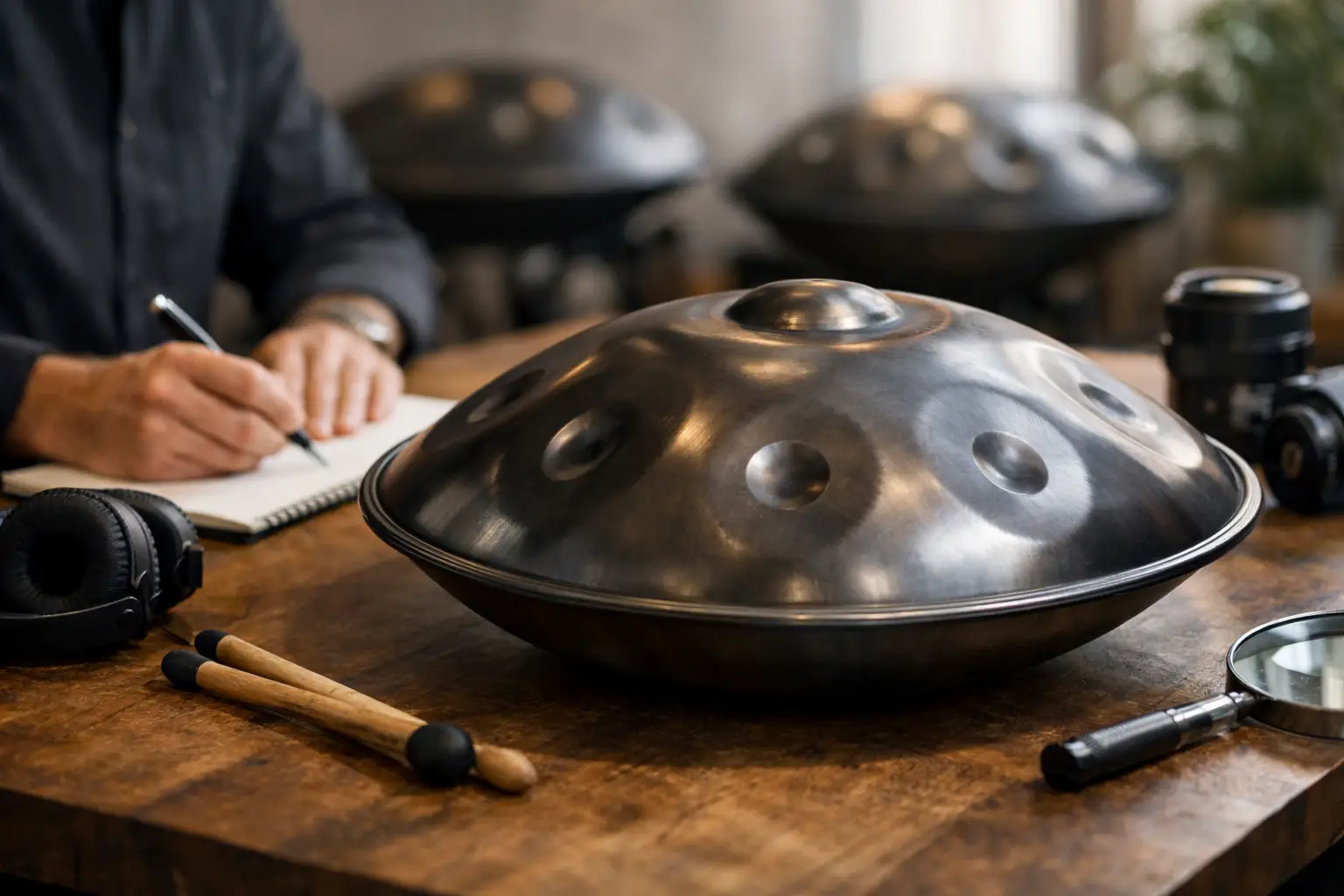
Professional Handpan Review for Serious Players
Professional Handpan Review for Serious Players
A handpan can sound beautiful in a short video and still feel uninspiring beneath your hands. That difference is where a professional handpan review matters. For a player investing in an instrument for regular practice, sound work, recording or performance, the real question is not simply whether it makes a pleasant sound. It is whether the notes invite you to keep playing, respond clearly to your touch and remain musically dependable over time.
A professional-quality handpan is a meeting point of skilled shaping, careful tuning and your own musical intention. It should offer enough ease for spontaneous moments of calm, while holding enough depth for a player who wants to develop phrasing, rhythm and a recognisable voice.
What separates a professional handpan from a beginner instrument?
The word professional can be misleading. It does not mean an instrument is only for touring musicians or trained percussionists. It describes a standard of musical responsiveness and craftsmanship that gives a committed player room to grow.
At its best, a professional handpan has clear note separation, stable tuning, balanced volume and a connected tonal character across the scale. You should be able to play gently without notes disappearing, then add energy without the sound becoming harsh or muddied. The instrument needs to reward subtlety as much as it rewards rhythm.
This matters whether your playing happens in a lounge room, a yoga studio, by the coast or on stage. A handpan is not merely struck. It is touched, listened to and shaped through small changes in timing and pressure. When the tuning is precise and the steel responds well, those small choices become audible.
The tuning should feel coherent, not just correct
Every tone field on a handpan contains more than one voice. Along with the central fundamental note, there are higher partials that give the note its colour and depth. On a well-tuned instrument, these voices sit comfortably together. The note feels rounded and clear rather than wobbly, metallic or strangely split.
Just as importantly, the notes should belong to one musical landscape. A handpan scale is designed so that players can create flowing melodies and satisfying harmonies without needing years of theory. Yet some instruments feel more connected than others. A professional handpan lets you move from the central ding to the edge notes and hear a natural conversation rather than a collection of separate sounds.
Listen for sustain, but do not treat more sustain as automatically better. Long resonance can be spacious and meditative, especially for slow melodic playing. In fast rhythms or amplified performance, though, too much lingering sound can blur the next phrase. The ideal amount depends on how and where you expect to play.
Note separation reveals the instrument’s control
When you play one tone field, nearby notes should remain calm unless you intentionally bring them into the phrase. This is called note separation, and it is one of the clearest signs of a refined handpan.
Poor separation can make an instrument feel busy before you have even begun to explore it. Notes trigger each other accidentally, low tones boom over everything, and delicate patterns lose their shape. In contrast, good separation lets you build complexity gradually. You can play a simple pulse, add melody, then bring in soft ghost notes and percussion without sacrificing clarity.
For sound healing practitioners, this control supports a more settled listening experience. For performers, it means your rhythms can travel through a room with purpose. For beginners, it reduces frustration and makes the instrument feel welcoming from the first session.
A professional handpan review should consider feel
Sound is only half the experience. A handpan may be beautifully tuned, yet its surface tension, note size and physical response can make it a poor match for your hands or style.
A responsive instrument speaks with a light, relaxed touch. You should not need to hit it hard to find a full note. Heavy-handed playing can damage any finely tuned steel instrument, but a quality handpan encourages better technique because it gives you an immediate musical return at lower volume.
The shape and layout of the notes influence comfort too. Players with smaller hands may prefer a compact shell or a layout that keeps commonly used notes within easy reach. Someone drawn to fuller rhythmic playing may enjoy a larger instrument with generous tone fields and a deeper low end. Neither preference is more professional. The right fit is the one that allows your body to settle and your ideas to flow.
The finish also deserves attention. Some players love the raw, earthy character of a naturally finished shell. Others prefer a cleaner, darker or more polished appearance. Visual appeal is personal, but it should never distract from tuning quality, structural stability and the care required to protect the steel.
Material and craftsmanship: what you can realistically expect
Handpans are commonly made from carefully treated steel, with stainless steel and nitrided steel among the materials players will encounter. Each can produce wonderful instruments, and neither is a universal winner.
Stainless steel is often appreciated for its warm, lingering resonance and sensitivity to a gentle touch. It can be especially appealing for slow, spacious music, meditation and melodic exploration. Nitrided steel is often valued for its focused, earthy sound and defined attack, which can suit rhythmic players and settings where clarity matters. Individual makers, shell shaping and tuning style have a major influence, so material alone cannot tell the whole story.
What should concern a serious buyer is consistency. The shell should feel solid, the notes should be carefully formed, and the instrument should have been tuned with patience rather than rushed into a finished look. Handmade instruments naturally vary, which is part of their character. But character is not an excuse for unstable notes, uneven volume or distracting overtones.
A professional instrument also asks something of its owner. Keep it dry, handle it with clean hands and use a suitable case for travel. In much of Australia and New Zealand, changing coastal humidity, heat and long drives can challenge any steel instrument. Regular, simple care helps preserve both its appearance and its voice.
Choosing a scale for your musical life
The scale is often the most personal decision in a handpan purchase. It determines the emotional atmosphere of the instrument and the pathways that open under your hands.
Minor scales can feel introspective, cinematic or deeply calming. Major scales tend to offer brightness and lift. Kurdish, Celtic, Integral and other popular handpan scale families each carry their own mood, but the name matters less than your response. If a scale makes you pause, breathe and play the same phrase again, pay attention to that feeling.
For professional use, think beyond the first captivating minute. Will you still find fresh patterns after a few months? Does the scale fit the settings where you work? A gentle, spacious tuning may be perfect for one-to-one sound sessions but less suitable if you need strong rhythmic definition with other musicians. A compact scale can be wonderfully focused, while a handpan with more notes offers broader harmonic options but may require more deliberate navigation.
There is no need to choose the most complicated layout to be taken seriously. Many experienced players build remarkably expressive music from fewer notes because they understand the voice of the instrument deeply.
The practical test: how it behaves in real playing
If you can play a handpan before buying, begin quietly. Strike the ding, move slowly around the scale and let each note fade. Then repeat notes at different volumes and listen for changes in pitch, rattles or unwanted ringing.
Try a simple rhythm with alternating hands. Add a melody over it. Play near the edge of a tone field, then closer to its centre. These small tests reveal more than a fast, impressive flourish. You are looking for a handpan that remains composed when your attention moves between rhythm, melody and silence.
If you are buying online, clear recordings are valuable, but listen with discernment. Audio can be altered by microphones, rooms and processing. Ask whether the recording lets you hear gentle playing as well as louder passages, and whether each note is demonstrated. A specialist retailer such as Handpans Australia can help translate those details into a choice that suits your goals rather than simply chasing a particular look or scale name.
Is a professional handpan worth the investment?
For someone who only wants a casual decorative object, probably not. But for a person who feels drawn to return to the instrument, quality is not a luxury detail. It shapes the relationship.
A handpan that is in tune, responsive and emotionally resonant makes practice feel less like discipline and more like a place you want to visit. It can carry a quiet morning ritual, support a room full of people in stillness, or give a live set a sound that cannot be mistaken for anything else.
Choose the instrument whose voice stays with you after the last note fades. That is often where the most meaningful music begins.