How to Play Hang Drum with Ease and Feeling
How to Play Hang Drum Guide
A handpan can sound beautifully complete with only a few notes, but that does not mean you need to force a performance from it. Learning how to play hang drum begins with listening: to the sustain after each touch, to the space between notes, and to the natural mood of your scale. Whether you are playing for your own quiet reset, accompanying a yoga class or building ideas for the stage, the most moving music often starts with a gentle, unhurried rhythm.
The instrument commonly called a hang drum is more accurately known as a handpan. The Hang was the original instrument that inspired this family of melodic steel percussion, while handpan is the broader name used today. Whatever you call it, the invitation is the same: let your hands explore a tuned landscape of rhythm and resonance.
Set yourself up to hear the handpan properly
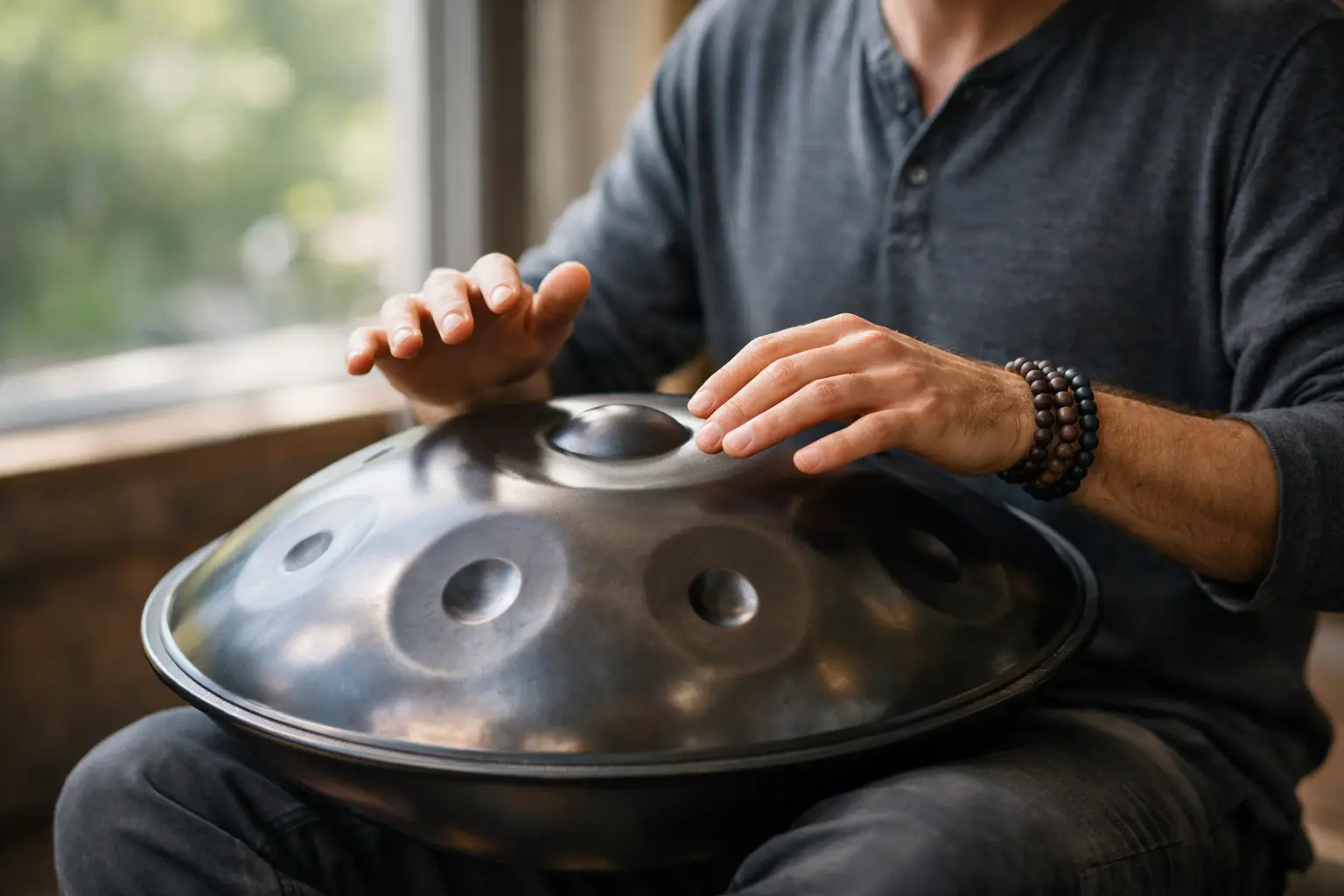
Sit somewhere comfortable and reasonably quiet. Place the handpan on your lap with the central note, called the ding, facing upwards. Keep both feet on the ground and angle the instrument slightly towards you so your hands can move naturally across its surface. A handpan stand can also be useful for seated or standing playing, particularly in a wellness setting or performance.
Before you think about patterns, rest your hands above the notes. Let your shoulders drop. Tension is one of the quickest ways to make a handpan sound harsh or muted, while relaxed wrists allow your fingers to rebound cleanly.
Your aim is not to hit the steel hard. Think of each touch as a light, controlled bounce. The hand makes contact, then immediately lifts away so the note has room to sing. If your hand stays on the note for too long, it dampens the resonance.
How to play hang drum with your first clean notes
Start with the ding in the centre. Use the padded part of a finger near the first knuckle, or the base of your palm, and give it a soft tap. Listen for a warm, round tone rather than a sharp metallic clack. Every handpan responds a little differently, so spend a few minutes finding the pressure that brings out its clearest voice.
Then move to one of the tone fields around the edge. Strike near the centre of that note with a relaxed fingertip. You may notice that a slightly different spot produces a richer sound. This small exploration is worthwhile. A handpan is tactile, and learning its individual response is part of forming a relationship with it.
Try alternating hands slowly: right hand on the ding, left hand on a nearby tone field, then right hand on another tone field. Leave a full breath between each note. At this stage, silence is not empty space. It is where the previous note becomes audible.
If you hear buzzing, dull thuds or accidental notes, slow down rather than striking more firmly. Usually the answer is a lighter touch and a quicker lift from the surface. Trim long fingernails if they catch on the steel, and remove rings or bracelets that could scratch the instrument.
Begin with pulse, not complicated rhythms
A steady pulse gives your playing a place to settle. Count quietly to four and play the ding on count one. Add a lower note on count three. Repeat this for a minute without changing anything. It may feel simple, but a dependable pulse is what makes a handpan feel grounding to the player and calming to the listener.
Once that feels comfortable, add a gentle higher note between the main beats. You might play ding, pause, outer note, pause, lower note, pause, outer note, pause. Keep the pattern soft enough that you can hear each tone decay before the next one arrives.
There is no need to play constantly. Many beginners rush because the instrument is so satisfying to touch, but a handpan rewards restraint. A rhythm with two well-placed notes can carry more feeling than a busy sequence with no space.
Try speaking a simple phrase while you play, such as “here I am, breathing slow”. Let the natural rhythm of the words guide your hands. This can be especially helpful if formal counting feels stiff or unfamiliar.
Find melodies inside the scale
One of the joys of a handpan is that its notes are chosen to work together. This means you can explore melody without needing to know every detail of music theory. Begin by travelling from a low tone field to a higher one, one note at a time, then come back down. Let your ear decide which note feels like home.
The ding often provides that feeling of return, but it depends on the scale and the way the handpan is tuned. Some scales sound bright and open, while others hold a more reflective or meditative character. Rather than trying to memorise a “correct” melody, play three or four notes and repeat the phrase. Repetition gives the listener something to hold onto.
A useful early exercise is to create a musical question and answer. Play a short phrase with your right hand, pause, then reply with a similar phrase using your left. The answer does not need to match exactly. It simply needs to sound connected. Over time, this call-and-response approach can become the foundation of your improvisation.
Add texture without losing the calm
As your hands become more confident, you can bring in different sounds. A light tap on the shoulder of a tone field can create a softer, percussive accent. Brushing the surface very gently can add movement, although it should never sound like scraping. You can also mute a note by leaving a finger on it briefly after striking, creating a shorter, drier sound among longer sustained tones.
These textures are best used sparingly. If every note has a different technique, the music can lose its centre. Start with a clear pulse and melody, then add one small accent every few bars. Let the resonance remain the main character.
It also helps to practise dynamics. Play the same pattern quietly, then a little more firmly, then return to quiet. The goal is not maximum volume. It is control. A sensitive handpan player can shape a room with a whisper as effectively as with a stronger rhythmic passage.
A simple 10-minute practice ritual
Consistency matters more than long sessions, especially when you are developing touch and timing. Set aside ten minutes where you are not trying to impress anyone. Spend the first two minutes playing single notes and listening closely. Use the next three minutes for a steady pulse around the ding, then three minutes for a short melody made from just three or four notes.
Use the final two minutes for free play. Follow what sounded good during the session, but keep returning to the pulse if you feel lost. Recording yourself on your mobile can be surprisingly useful. You will hear whether the rhythm stays steady and which phrases have genuine shape, even if you are only playing for yourself.
Some days your practice may feel meditative and spacious. Other days you may want to build a faster groove. Both are valid. The important thing is to meet the instrument where you are, rather than judging every session against an imagined standard.
Care for the sound as you learn
Handpans are finely crafted steel instruments, so a little care protects both their finish and their voice. Handle yours with clean, dry hands, keep it in a well-padded case when travelling, and avoid leaving it in direct sun, a hot car or damp conditions. Wipe away fingerprints after playing with a clean microfibre cloth. If you are interested in Purchasing a Handpan We sell a variety of high quality instruments here.
Oil care depends on the material and finish of your handpan, so follow the maker’s recommendations rather than applying products at random. If you live near the coast or in a humid part of Australia or New Zealand, regular checks for moisture or surface changes are particularly sensible. A well-cared-for instrument remains a more responsive companion for years of playing.
The most rewarding way to learn is to return often, without pressure. Sit down, play one note that feels good, and let the next note arrive when you are ready. In that quiet exchange between hand and steel, your own musical voice has room to appear.