

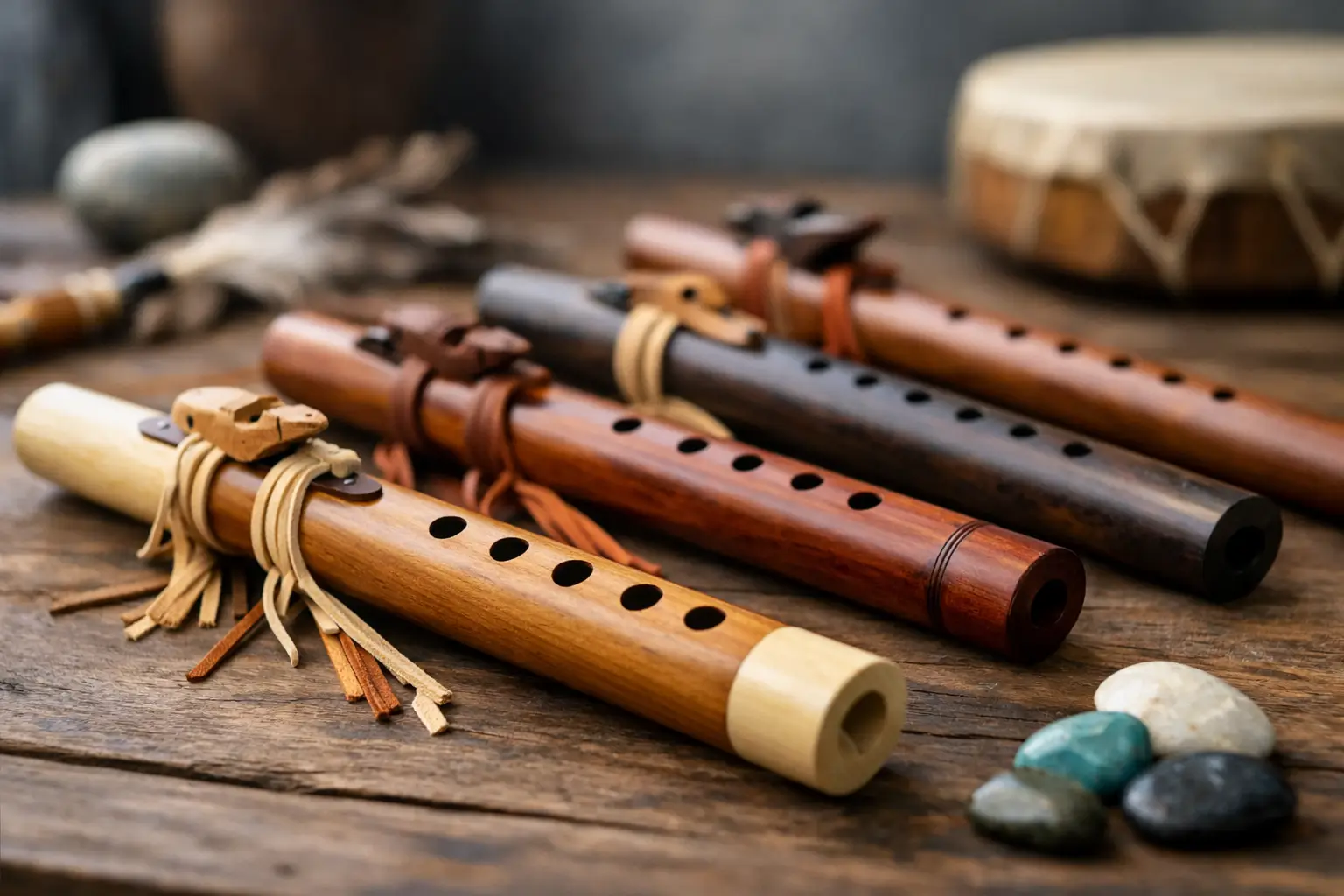
Native Flute Key Selection for Every Player
Native Flute Key Selection Guide for Every Player
A Native American flute can feel like a quiet companion from the first breath, but the key shapes that relationship. Native flute key selection is not about finding one objectively ‘best’ note. It is about choosing the voice, size and musical range that feel natural in your hands and speak to the kind of moments you want to create.
A low flute may offer an earthy, spacious tone that settles a room. A higher flute can carry more easily, add brightness to an ensemble and feel wonderfully nimble under the fingers. Both can be deeply expressive. The right choice depends on your breath, your body, your musical ear and the sounds you hope to play alongside.
Start with the feeling you want to create
Before comparing letter names, picture where your flute will live. Is it for a few reflective minutes on the verandah at dusk? Gentle melodies in yoga or meditation sessions? Improvising with a handpan, guitar or voice? Or perhaps performing where the instrument needs to be heard clearly beyond your own space?
Lower keys such as A, G and F# are often chosen for their warm, rounded character. Their notes have a grounded quality, with more air and depth in the sound. They suit slow phrases, spacious pauses and melodies that feel close to the earth. Many players are drawn to these keys for personal practice, sound-based wellbeing and accompaniment that does not feel hurried.
Mid-range keys, particularly F, E and D, are a beautiful meeting place for many players. They retain enough warmth for reflective music while being a little easier to carry, hold and play for longer periods. D is widely loved as a versatile all-round key, especially for players who want one flute that can move between private practice, casual jam sessions and simple recording.
Higher keys such as C, B and A have a clearer, lighter voice. They respond quickly, travel well and can sit above lower instruments without disappearing into the mix. A high flute can be a lovely choice for melodic improvisation, outdoor playing, or anyone whose hands find larger flutes uncomfortable.
There is no hierarchy here. A high C is not a beginner’s compromise, and a low A is not automatically more advanced. Each key creates a different emotional landscape.
Native flute key selection begins with comfort
The pitch of a flute affects its physical dimensions. As a general rule, lower-pitched flutes are longer, with wider finger-hole spacing and often a larger bore. Higher flutes are shorter, lighter and usually easier for smaller hands to reach around.
That does not mean every player with smaller hands must choose a high flute. Makers use thoughtful hole placement and ergonomic designs, and hand flexibility differs from person to person. Still, comfort deserves more attention than it often gets. A flute that sounds magnificent but strains your fingers can quietly discourage practice.
If you are purchasing your first instrument without trying it in person, a mid-range flute is often a sensible starting point. D, E or F tend to provide a rewarding balance of mellow tone, manageable size and broad musical usefulness. If you know you are especially drawn to a deep, low voice, consider whether a larger instrument will be comfortable during a relaxed 15-minute playing session, not only for a quick test.
Breath matters too. Larger, lower flutes may ask for a fuller, steadier airstream. This is not the same as needing force. Native American flutes respond best to calm, supported breath rather than pressure. A higher flute generally speaks with less air, which can make it feel immediately accessible for a new player. Yet some beginners naturally enjoy the slow, grounding breath of a lower instrument. Your body will often tell you more than theory can.
Do not confuse the key with the scale
A flute’s key tells you its tonal home – for example, D or F#. Its scale tells you which notes are most naturally available and how the melodies tend to feel. Many Native American-style flutes use a minor pentatonic tuning, a five-note framework that makes it easy to create musical phrases without needing years of formal theory.
This is part of their quiet magic. You can explore, pause, repeat a motif or follow your ear, and the flute gives you a strong chance of landing somewhere harmonious. Depending on the maker and tuning, cross-fingering and breath control can reveal further notes and colours.
When comparing instruments, listen for the whole personality rather than judging by the key name alone. Two flutes in D can have distinct voices due to their timber, bore design, wall thickness, tuning approach and craftsmanship. One may be smoky and intimate; another may be bright and open. The key is a useful starting point, not the entire story.
Choosing a key to play with other instruments
If you want your flute to join a handpan, tongue drum, guitar or other melodic instrument, compatibility becomes a practical part of native flute key selection. The simplest option is to choose instruments with the same root note or closely related scales.
For example, a D flute can pair beautifully with a handpan or tongue drum centred around D, particularly when their scales share similar minor or pentatonic colours. An F# flute may feel at home with an F#-centred handpan. Even then, listen rather than relying only on labels. Scales can contain different notes, and a combination that looks compatible on paper may feel busy or unresolved when played together.
A little contrast can be wonderful. A low flute beneath a brighter tongue drum can create a conversation between earth and light. The trade-off is that playing together requires more listening. Start by holding long notes on the flute while the other instrument establishes a gentle pulse. Notice which notes rest comfortably and which create tension. Neither is automatically wrong – tension can be expressive – but it should feel intentional.
For sound sessions, keep the flute’s role in mind. A lower key may blend into a handpan’s resonance so softly that it becomes more texture than melody. A higher key will often rise above the sustain and give participants a clear melodic thread to follow. Neither approach is better. It depends on whether you want the flute to cradle the soundscape or lead it.
One flute or a small family of keys?
Many players eventually collect more than one flute because each key invites a different kind of music. That does not need to be your plan on day one. One well-chosen flute can offer years of discovery.
If you are beginning with a single instrument, choose for the music you will actually make most often. Select a mid-range D, E or F for broad versatility. Choose low A, G or F# if you already know that deep, meditative resonance is what moves you. Choose C or another higher key if portability, easy reach and a clear melodic voice matter most.
Later, a complementary second flute can expand your palette. A player who begins with a low G may enjoy adding a higher C or D for contrast. Someone with a bright high flute may eventually want a lower key for slower, more spacious work. Think of each new key as a new shade of the same familiar voice.
Listen with your own ear, not someone else’s
Audio recordings are helpful, but they cannot fully convey how a flute feels against your fingers or how its resonance meets your chest in a quiet room. If you can hear examples through good headphones, pay attention to the notes that make you instinctively slow down, breathe more deeply or want to answer with a phrase of your own.
Avoid choosing only because a certain key is popular or because a performer makes it sound extraordinary. Their hands, breath, room acoustics and musical purpose may be very different from yours. A flute becomes personal through the time you spend with it, not through its specifications alone.
It is also worth approaching the instrument with respect for the living Indigenous traditions connected with Native American flutes. Learn from makers and players who acknowledge that heritage, and let your own practice be guided by care, listening and genuine appreciation.
At Handpans Australia, we see the best instrument choices begin with a simple question: what kind of sound do you want beside you when words are not needed? Follow that answer. The right key is the one that keeps calling you back for one more breath, one more note and one more unplanned melody.